By 1879 James McNeill Whistler was 45 years old and in a bad way. He’d won his libel case against John Ruskin’s accusation that he’d ‘flung a pot of paint into the public’s face’, but was awarded only a farthing in damages. He’d lost an important and generous patron, Frederick Leyland. In fact, by now he’d alienated many people thanks to his habitual wrangling and belligerence. All this left him in severe debt, and in May 1879 he was declared bankrupt.

His response was to abandon London and move, with his current girlfriend, Maud Franklin, to Venice, where he remained for more than a year. It was a small help that he’d been given a commission of £150 from the Fine Art Society, a commercial gallery, to provide twelve etching plates of the city. He was told to submit these within three months of his arrival. Characteristically, he ignored the instruction, turning first to other media, especially pastel, which seemed to evoke the subtle colours and tones of the watery city better than the sharp edges produced by the etching needle.

In the end Whistler did produce his etchings, which were exhibited in the rooms of the Fine Art Society in December 1880. They were not a critical success. One reviewer condemned them as ‘too slight in execution and unimportant in size’. But this was to misunderstand. Whistler wasn’t aiming for grandeur or perfection. Instead, he was developing a new kind of printmaking, and looking at Venice, for centuries a staple of the artistic landscape, in a new way.

He was making a return to etching. In his early artistic career he’d produced some of his most innovative and striking works in his ‘Thames Set’ of sixteen etchings in 1859-61. Since then, other media, especially painting, had supplanted printmaking in his practice. Now that he was being steered back to the medium, he was determined to do something new with it.

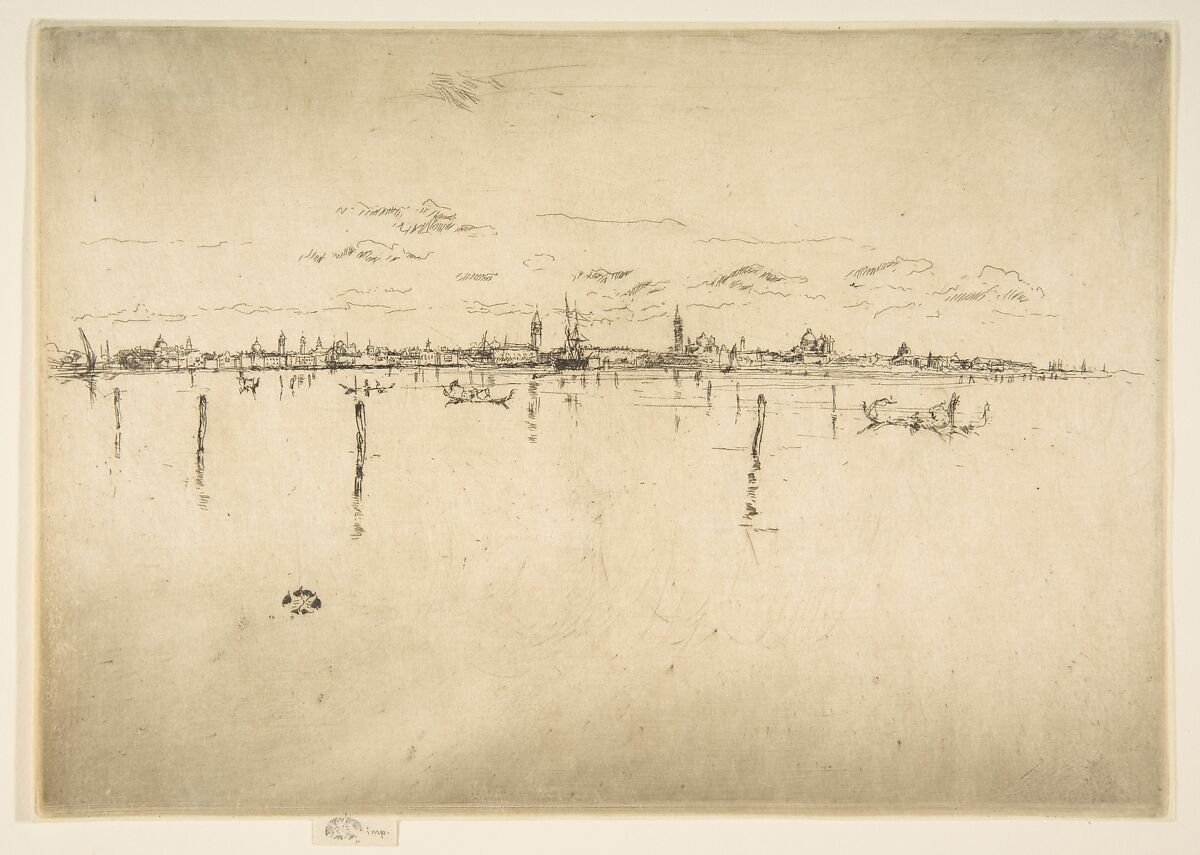
What strikes you straight away about the twelve prints is the variety of their subject matter. A few, like Little Venice and Nocturne, take a traditional view of the lagoon, with a line of waterside buildings or boats in the distance (no doubt Whistler had London gallery sales in mind). But in others he retreats from the grander scenes of the kind sought by Canaletto or Turner, and focusses on details of the inner streets and back lanes of the city, unvisited by tourists: doorways (The doorway, Two doorways), gloomy passageways (The beggars) and insignificant street furniture (The little mast). This approach, what Whistler termed ‘the Venice of the Venetians’, echoed his preference in the ‘Thames Set’ for working class riverside scenes in Wapping and Rotherhithe, rather than more fashionable parts of London.

Even more striking is Whistler’s treatment of his pictures, so different from that of traditional etching and his own earlier works in the medium. The riva shows, from a high vantage point, the bustle of the shoreline, full of the scattered figures of workers, residents and visitors. Behind them is an intricate tapestry of boats, bridges and buildings. Again, the view resembles the complexities of the earlier Thames etchings, but there are new elements: Whistler outlines many of his figures, like the gondolier, in a vague, impressionistic style, and he isn’t afraid to leave large areas of the picture blank or sketchy. The doorway contrasts this emptiness, in the upper angles and the foreground, with a highly detailed central section reproducing the ornately carved doors of a building and the dark interior. A woman stares towards the water, the movement of which Whistler subtly suggests with modulation of tones. This composition is reversed in The beggars, where distant figures are silhouetted against the light at the end of the passage, and in The traghetto, a small masterpiece. Here Whistler manages to train the leafy branches of three trees against both the lightness of the façade and the darkness of its interior. The traghetto (large gondola) of the title is a tiny detail in the distance, on the far side of the passage. In the foreground, the paving stones fade into sunlit invisibility, and four Venetians at a table, a girl with baby and three windows are all sketchily outlined, with tiny scratches of the plate, as if in a hastily done drawing.

The palaces makes an even stronger contrast between the crisply etched complexities of the facades of the grand buildings in the centre with large areas of reserved areas of sky and water (though a smoother application of ink suggests waves in the latter). Whistler used the same mix of exact precision and vague impression in The piazetta.

By now he had mastered completely the full range of the etcher’s craft: not only expert use of the needle to expose the copper plate under the acid-resistant ground, but also enriching with drypoint (to create soft, rich lines, without acid) and plate tone (a film of ink left on the plate after wiping). He took responsibility for ‘biting’ his own plates, and creating the prints, using antique paper of high quality.

The first set of Venice etchings were exhibited by the Fine Art Society in 1880, and were published in the same year. The initial reaction was cool: people were disappointed in Whistler’s unorthodox choice of subjects. But he wasn’t discouraged. He exhibited a further set of etchings, the ‘second Venice set’ in 1883 (published in 1886). In the catalogue, in his usual combative way, Whistler reproduced the negative comments made by critics of the first set (‘another crop of Mr Whistler’s little jokes’). He continued to work on the etchings for years, and their publication brought them to new audiences. And he produced more etchings in other locations, notably Amsterdam in 1889.

Opinion has changed since the initial reviews, and today the Venetian etchings are ranked with the best of Whistler’s artistic output. Few artists could create such perfectly balanced compositions, or such varied and subtle effects of light and shade, using a medium that seems so cramped in its scope and power.
After a long period of neglect, etching has seen a renaissance since the 1970s, with artists like David Hockney, Frank Auerbach, Chris Ofili and Louise Bourgeois. Whistler’s works set a high standard for contemporary printmakers.

Tate Britain is soon to stage the first major European retrospective of Whistler’s work in thirty years (21 May – 27 September 2026).
Leave a Reply