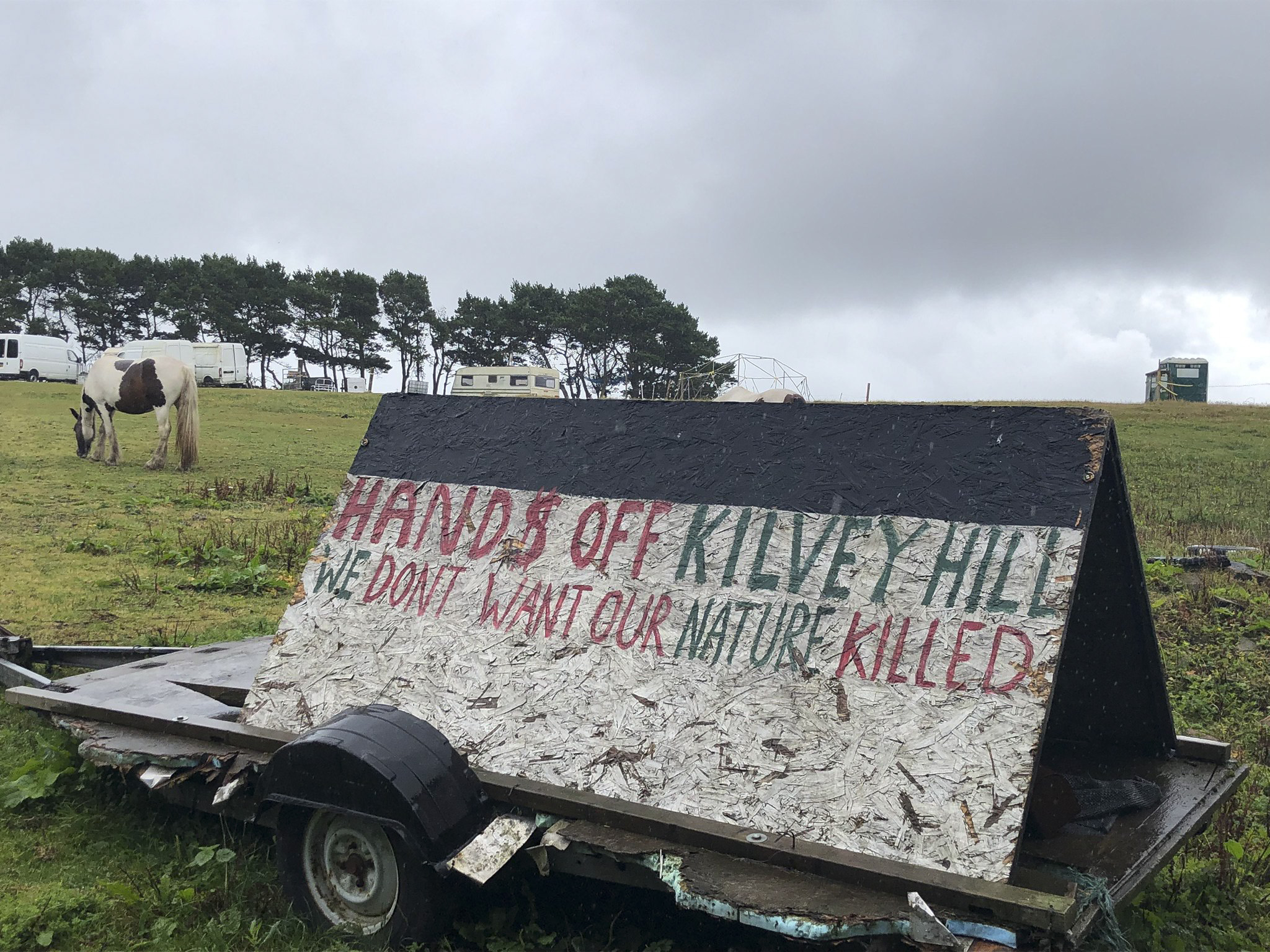
Swansea, like Rome, is built around several hills, but the tallest of them is Kilvey Hill, just to the east of the city centre. The Welsh form of Kilvey is Cilfái (‘nook in an open place’), though the original name, it seems, was Y Bigwrn. Pigwrn means ‘peak’, but it can also mean ‘ankle’, and the Hill does resemble an ankle or foot, rising gently from the north and falling more sharply to the south and west. For many years it’s been a quiet, wooded retreat for people fleeing on foot the heat and noise of the city. On a good day the summit offers fine views, east towards Neath, Port Talbot and the hills behind, ahead to the empty docks, and west to Mumbles Head.

It wasn’t always like this. From the eighteenth century what became the world’s greatest concentration of copper works grew rapidly in the valley of the Tawe below. For decades in the nineteenth- and early twentieth-centuries fumes and smoke spewed from the works, day and night. South-westerlies blew the pollution up the valley and across Kilvey Hill. While dangerous metals leaked into the soils of the lower Tawe, airborne poisons gradually killed the trees, plants and other living things that had found a home on the Hill for centuries. The area became one of the most polluted industrial sites in Europe.
The poet Edward Thomas visited the lower Tawe valley in 1914 and published an essay, ‘Swansea village’, in which he wrote of the west-facing slope of Kilvey Hill:
…it has been stripped by poisonous smoke and covered with a deposit of slag, except on the perpendicular juts, which reveal the strata of blackish rock; a chimney pierces the summit and stands out against the sky.
After the copper industry died, a large-scale clean-up in the 1960s, the Lower Swansea Valley Project, scrubbed the valley floor of most traces of industry – only parts of the Hafod Works, recently restored, now survive – and created a new landscape, with woodland and paths, to restore nature and encouraging community use. Kilvey Hill was also revived. Toxic waste was removed, and, in phases from the 1970s to the 1990s, the slopes were re-wooded, with both coniferous and broadleaf trees, to shape a new ecosystem of great environmental and recreational worth.

But today Kilvey is under attack again. Not this time by traditional industry, but from a different, more contemporary business, mass tourism. A New Zealand company, Skyline Enterprises, ‘leaders in designing and delivering gravity-fuelled visitor experiences’, has been allowed to build a large entertainment complex on the summit and the flanks of the Hill, at a cost of many millions of pounds.
This is what the company says it plans:
Skyline Swansea will create an accessible cable car ‘gondola’ which rises from the Copper Quarter to reach the summit of Kilvey Hill. At the top of the hill, gravity-powered downhill karting ‘Luge’ rides await, with a sky swing, walking and mountain biking trails, a children’s playground, and places to eat and drink. When completed, all existing public access routes will be maintained and new trails created.
I’d heard that work on the ground had already begun, so a couple of weeks ago, R., a friend who’d never been to the top of Kilvey, and I took a circular walk from the centre of Swansea to see for ourselves.

We crossed the Parc Tawe bridge and walked up the path between the river and the road towards Hafod. The path follows an old railway line, and it’s well used by walkers, runners and cyclists. We left it just before Hafod, crossed the main road (a hazardous manoeuvre) and took the turning to Pentre-chwyth.
Before we got to the village, one result of Skyline’s work was already plain to see: a broad gash in the woodland, extending from where we stood to the horizon. This is the mile-long route of the ‘gondolas’ that will take visitors from their ‘base station’ at the Landore park-and-ride car park, sail high above the ground from tower to massive tower, and come to rest at the summit of the Hill. Presumably a parallel line will be a ‘zipwire’ (there’s also something called a ‘sky swing’, or this may be the same thing) that will swish people back down the hill at 50mph. How many trees and other plants have been uprooted, how many animals and insects expelled, we wondered, to make way for these wonders?

We’ve no answer, and pass on. Soon we come to Pentre-chwyth (‘windy village’), a well-preserved set of Victorian hillside terraces where copper workers must have lived. Beyond the top terrace we join a path through what’s called the Kilvey Community Woodland. As we climb, the path links to a wider, spinal track and then, still climbing, to a broad lane leading towards the summit.

Except that we never reach the summit. Wire screens and a banksman bar our way. The man stands up as we approach. He has long wooden pole and a fierce look, but he turns out to be friendly and helpful. He tells us where we can’t go (straight ahead) and where we can (a path to the left), and even seems to hold heterodox opinions about the Skyline development. On the other side of the wire is a large expanse of bare earth, where all vegetation has been erased. Dust rises from excavators trundling in the distance.
What we’ve seen is just part of the ecological destruction. Skyline also plan a large adventure playground and at least three ‘luge tracks’, each over 1,000m long, that will twist their way down the Hill, eliminating even more trees.

We say goodbye to the banksman. The alternative path swings around to the east, past the big solar panel array that’s visible from the motorway below. Suddenly we arrive at another wall of wire fences. Looking through them we’re faced with a scene of desolation. The only familiar sights are the tall communications masts on the summit. All around them is bald earth, again populated with diggers, tractors and vans. The green life that was here before has been eliminated, to make way for the exciting visitor facilities that are planned, including ‘places to eat and drink’ and ‘retail opportunities’. This special place, which before was a quiet, meditative place for surveying the city, the sea and places beyond, will never be the same.

We find a way down the Hill, stumbling down the paths, lanes and streets of St Thomas (another of Swansea’s villages that’s remarkably well preserved), only rejoining the familiar route towards the bottom. R. had finally climbed Kilvey Hill, but had still failed to stand on the summit.

It’s been a good, energetic walk, but a deeply depressing one. Swansea Council, drunk on grands projets and contemptuous of public opposition, pushed through the Skyline plans with little scrutiny. It committed public money and persuaded the Welsh Government to grant another £4m from its own capital funds (the total public ‘investment’ is over £12m). The Council ‘disposed of’ large amounts of land to the company.
Those opposed to the plans have posed many questions, most still unanswered. Why has consultation been so poor? Why has commercial exploitation been allowed to override environmental and community interest? Has there been sufficient scrutiny of Skyline Enterprises and its plans? (The company predicts 550,000 visitors a year, an ambitious target for Swansea.) What will happen if the venture fails? Despite mitigation measures, will wildlife, tree numbers, heritage sites not be badly affected? What about direct environmental costs, like water and sewage? Where will we go now to find peace and quiet?

But now it’s too late. The project’s going ahead, and Kilvey Hill faces a new dark age.
Skyline Enterprises has a vision, ‘to open up Kilvey Hill for everyone to enjoy, bringing accessible tourism to the heart of Swansea.’ This is the exact opposite of the truth. The Hill is already ‘open for everyone’. In future it will effectively be closed, for those who value its tranquillity and natural beauty. Not a vision, then, but a nightmare.


Leave a Reply