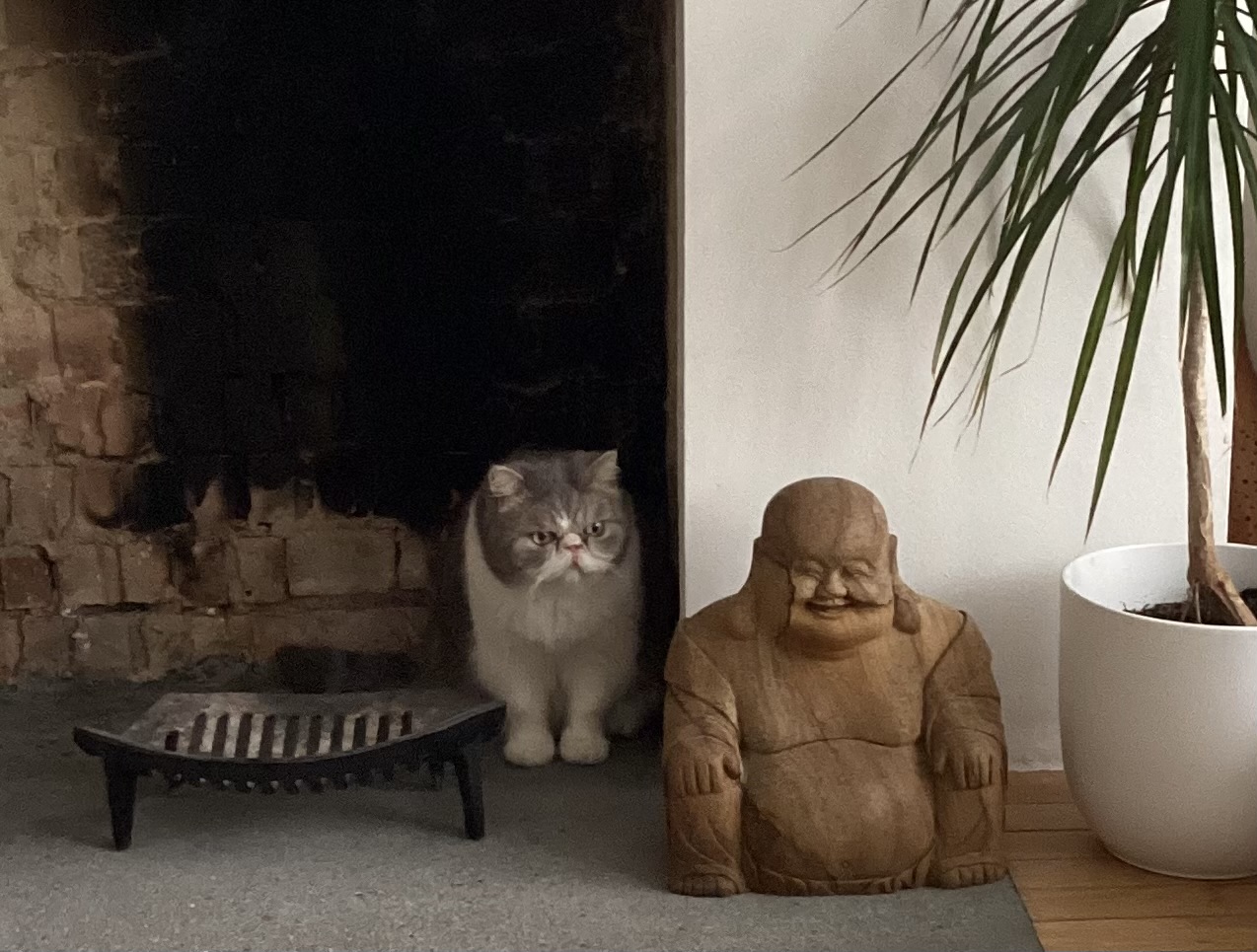
Before long Michael will be moving home, from a small London flat to a small house a mile or so away. This is the kind of change, you might say, that happens all the time. Most people manage it without much stress or fuss. After the initial disruption and excitement, they get on with their lives.

But Michael is a cat, an Exotic Short Hair to be precise, in the care of our younger daughter, and he never leaves his flat. That’s not strictly true. He’s been to the vet a time or two, and he once fell out of the window (he was eventually found, uninjured, in the flower bed below). The point, though, remains: Michael’s entire world is coterminous with the walls of his flat.
Until neurological science has progressed a good deal further, we won’t know what goes on in the head of an animal like Michael. Beyond, that is, a few basic thoughts and feelings that we might infer, rightly or wrongly, from his behaviour. We can’t know how he sees the world around him, or thinks about its nature and extent. What’s certain that the world he knows is a very small one. He might retain memories of his brief extra-flat experiences – not quite impossible, since the vet treatment and the fall into the flower bed might have left lasting, traumatic marks. He’s also able to look out of the window at a lawn and another two blocks of flats. But otherwise his world consists of four rooms and their contents, his two owners, and visiting friends and relations.
So Michael knows nothing of the rest of London, let alone places beyond. He’s never been to Buckingham Palace or Bunhill Fields, Chelsea or Camden Lock, Harrow or Hackney Wick. He’s not even caught a glimpse of Penge High Street or a Croydon tram. But before we give way to sympathy or disdain for Michael’s boxed-in world view, we should consider the limits of perception that humans, too, might suffer from.

There are groups of people whose worlds are almost as confined as Michael’s. Hermits, for example, or prisoners. But they don’t quite fall into the same category as him, because they’re aware of – they’re able to recollect – a world beyond their current predicament. Prisoners might dream of their eventual release, or of heroic escape, whereas release or escape presumably have no meaning for Michael.
But there’s another respect in which all of us might be in the same condition of caged ignorance as Michael. How can we know that what we perceive with our senses – and with extensions to our senses, like microscopes and radio telescopes – give us anything like a complete picture of What There Is? Here we need to make a distinction between what scientists call the ‘observable universe’ and what may lie beyond it. The observable universe consists of what we already know and what we could reasonably know in future, given extensions of the power of our tools. No one has yet discovered dark matter or dark energy, but since there are strong logical grounds for inferring their existence, it’s possible that someone, sooner or later, will.
But, beyond the reach of any of our conceivable instruments, there may be more to the universe than we can possibly understand. One problem is that the speed of light can’t be exceeded, so shielding us from parts of the universe distant in space and time: light hasn’t brought us knowledge of objects beyond the ‘cosmic horizon’. We know that black holes swallow objects, but what happens inside them? Again, we may never be able to know, since none return who pass the ‘event horizon’. Another uncertainty arises from the possibility, entertained by some scientists, of entirely different, unobservable cosmic domains, or ‘parallel universes’.

(Some religions, of course, come equipped with ready-made parallel universes, like ‘heaven’ and ‘hell’, populated with suitable figures. I notice that our local Christadelphians are advertising meetings on ‘Angels as ministering spirits’, ‘The truth about demons’ and ‘Satan and the devil’. Like all parallel universes, though, their existence is untestable.)
The philosopher Colin McGinn argues that there may be absolute limits to knowledge that arise directly from our cognitive wiring as human beings (this theory is called ‘cognitive closure’). Problems that look intractable will remain so because we have no conceivable means, as humans, of solving them – just as a fish’s mind is ‘closed’ to the idea of life on land as opposed to life in water. Or, you might add, as a cat has no hope of coping with the idea of our more extended world.
Where does all this leave Michael? His internal life is as unknowable as McGinn’s unanswerable problems (and as the bat in Thomas Nagel‘s famous article, ‘What is it like to be a bat?’), but I like to think of him pacing around the flat on his own, rather like another room-prisoner, Xavier de Maistre, author of the classic A journey around my room, constructing histories for all the objects he sees and digressing into philosophical musings.

Whatever the case, before long, as I said, he’ll be leaving his beloved flat, his entire universe, and moving to a house, a brand new ‘parallel world’. I like to think of him reacting rather grumpily, like Xavier when he was released from house arrest:
Ah, why didn’t they let me finish my journey? Was it to punish me that they had locked me up in my room – in that delightful country that holds every good thing, and all the riches of life, within its realm? You may as well exile a mouse in a granary.
Centuries before Xavier’s time, Michael’s (and our) predicament was vividly described by Plato in Book 7 of The republic, in the allegory of The Cave and the Sun. Socrates, the narrator, imagines prisoners shackled within a cave:
In this chamber are men who have been prisoners there since they were children, their legs and necks being so fastened that they can only look straight ahead of them, and cannot turn their heads.
All they can see is moving shadows cast on a wall by invisible figures. These shadows are their ‘observable universe’. Only when freed from the cave into the light of the sun is a prisoner able to understand that the real world lies outside the the limited world of his previous perception. At first he would find the light dazzling, but
later on he would come to the conclusion that it is the sun that produces the changing seasons and years and controls everything in the visible world, and is in a sense responsible for everything that he and his fellow-prisoners used to see … and when he thought of his first home and what passed for wisdom there, and of his fellow-prisoners, don’t you think he would congratulate himself on his good fortune and be sorry for them?
Plato is no democrat, of course, and only the chosen elite are allowed into the light of the sun. But perhaps he was wrong anyway. Maybe it was the prisoners who were the realists, and not to be pitied for it. Certainly Michael should not be taken for granted. He’s always struck me as a philosophical cat. Maybe a bit of a Buddhist? Maybe, while stalking around the flat, he exercises his mind puzzling over the meaning of Zen koans? As our daughter says, ‘he’ll find acceptance, which is something humans seem to find more challenging.’


Leave a Reply