These days Lampeter is a quieter place than it was. The main reason is the loss of St David’s College. The closure of a university is a blow for any town, but when that town is small and rural and far from a rail line, and when it has no other economic focus, then the blow is disastrous. When I wander round the old campus there’s not a soul to be seen, and every building is locked. A sign at the Library entrance seems to say that you can still visit its wonderful special collections, but by prior appointment only.

But I’m not here to mourn happier times; nearly ten miles of walking lie ahead. Thanks to the speedy T1 bus, I’m on the road before 10:30, after a coffee in the Town Hall Café, next door to what used to be the Town Hall, where Jen Jones used to have her Welsh quilts museum. It’s sunny and warm for early September, though heavy clouds are already massing ahead of me to the west. The Trail leaves the Newcastle Emlyn road after crossing the bridge over Afon Creuddyn, and a path follows the stream down to the Teifi. Ahead I can see in the distance the grey outline of Mynydd Pencarreg and its communications mast. Somewhere on my right stood the eighteenth-century mansion called Peterwell, the home of the choleric, brutal and rapacious landlord Sir Herbert Lloyd. The mansion disappeared long ago, except for a couple of wall fragments, but Lloyd lives on as a vicious rogue in local memory, most vividly in Bethan Phillips’s book Peterwell.

The Teifi has seen some rain since I last saw it at the height of the final heatwave of the summer, and the flow of its waters has partially recovered. So too have the grasses, their savannah-like brownness beginning to fade. As the river slides by, birds are taking the morning air. I disturb a group of ducks, who clatter off the water with loud complaint. From my left a kingfisher jets past, flashes its wings at me and darts off downstream. Further down a heron lifts off, to avoid the vulgar company of a human blundering through the wet grass. And speaking of things vulgar, all along the banks are pink clouds of Himalayan balsam, the inextirpable scourge of most large Welsh rivers. Holes in the clay banks opposite used to be the homes of the sand martins, who are now preparing to migrate, or have already fled.

The river wanders from side to side, occasionally calving small lakes and ponds. In one pond is a family of swans. As I approach, a crocodile procession sets out for the river, the brilliant white parents leading seven grey cygnets. They celebrate their landing with a loud splash.
The riverside walk continues, but the Trail turns north, past a farm, to Pentre-bach, and follows the main road for nearly half a mile. This is possibly the most dangerous and unpleasant stretch of the whole Trail. Drivers pay little heed to the speed limit, and even less to poor pedestrians, who have to stop and press themselves into the hedge to avoid extinction. There’s no pavement and almost no verge. Mercifully, after passing Cwm Deri, the Trail turns off down a narrow lane to the left, and I can breathe again.

The lane leads to a farm called Ffynnon-Fair. As I approach it, I’m pondering whether St Mary’s Well might date from pre-Reformation times when a farmer emerges on a tractor and stops to chat. I ask him about the spring, and about the farm. He points to where the spring is and tells me that he’s been farming here since the 1960s, and still helps out his family, who will take over after him. And the farming, these days? Eitha da, he replies, which is probably farmer-speak for ‘excellent’, despite the summer drought. He’s not a local, he says, he came here from Llandinam in Montgomeryshire. We talk about David Davies Llandinam and the Davies sisters of Gregynog, and he says he can remember seeing the sisters, or at least one of them (Margaret died in 1963), arriving for Sunday church in Llandinam. All the locals would doff their caps and bow – not only out of deference, he claimed, but from true respect.

The Trail crosses some fields and then Afon Grannell, a tributary of the Teifi, over a stout metal and wooden bridge, and before long I’m in Llanwnnen. Llanwnnen’s a small village, best known to most people, including me, as a crossroads on the way to somewhere else. I’ve never stopped here before. An inscription on a plaque by the road reads, ‘Gosodwyd hanes Plwyf Llanwnnen o dan y garreg hon yn y flwyddyn 2000 i ddathlu y Mileniwn Newydd.’ I wonder whether the village’s past buried in this place may be richer than its present, because history here seems to be at a standstill.

The school, with its quirky mini-spire, was closed in 2017, to be converted into a house. The Grannell Hotel, where I shelter as I munch my sandwiches in the rain, looks closed, maybe permanently. The words ‘Llanwnnen Post Office’ are embossed in capitals on the wall of the house opposite the inn, but no post has passed through here for years. The church, too, is closed. It has a joint dedication, to St Lucia, whom I last met in her distant home town of Syracuse, and the mysterious St Gwynin, and its churchyard contains some nicely Gothic overgrown graves. Maybe the most attractive building in the village is a tin shed, wedged within a row of houses facing the church, with its peeling white and blue paint and its bold transomed and mullioned windows.

From the village the Trail sets off north, in the ‘wrong’ direction, and tracks along the edge of a beech wood. Beech is a tree that’s kind to the walker, whose feet tread softly on its shed leaves and mast. Next the path descends through fields and a lane back to the main road, crosses it, and takes me along another long lane. Just as the feet are beginning to complain of tarmac-fatigue, the Trail takes a turn to the left at Llanfechan to follow a fine sunken track, fields and another lane, past an abandoned farm. Many of the farms in this area, I notice, are empty, or have seen better days, their barns, sheds and old machinery gently rusting into the landscape.

I’ve reached the straight road that leads across the Teifi into Llanybydder. Instead of taking it I make a diversion for half a mile to visit Pontbren-du, the home of the quilt-collector Jen Jones, who kindly helped me with a book years ago. Luckily, she’s at home and welcomes me in to her symmetrically elegant eighteenth-century house. Though she no longer has a permanent museum in the Town Hall at Lampeter, she holds occasional quilt exhibitions there, and she’s busy planning the next. No one has done more than Jen to awaken interest in an art form at which Wales excelled, or to celebrate the remarkable women who made them.

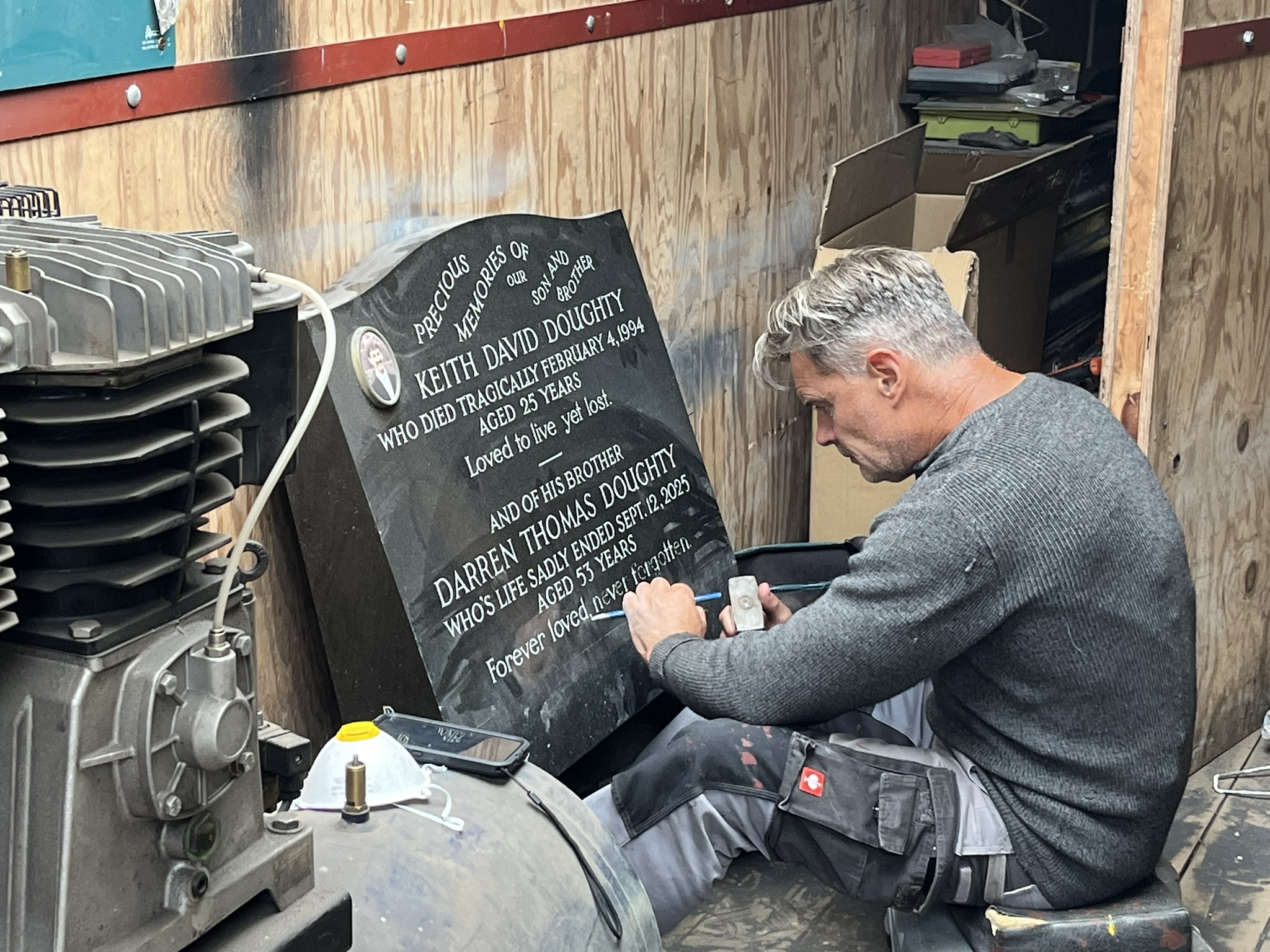
Jen gives me a printed guide to her last exhibition and we say farewell. I rejoin the Trail, following a short riverside path and then the Teifi bridge into the village. Straight after the bridge is a sign saying ‘John Jones, monumental mason’. I can hear a chipping sound coming from a large container to my right, and peer curiously inside. And there is John Jones, perched on a low cushion and hunched over a gravestone, chisel in hand. He’s adding a second name, below that of a man who died too early, to a polished black stone. He has two machines for lettering stones, he says, but they can’t produce the fine, individual results that only hand-lettering can give. Only a handful of hand-letterers are left working in Wales. Strangely, John never met a master of the craft, Ieuan Rees, who died last year. We talk in Welsh of other things: of eels that live in the river, of the still-felt loss of the railway line, of the shops that have closed in Llanybydder.

I wander round the village, past the curiously urban and long-abandoned Lloyds Bank; the Black Lion pub; Dolgwm stores, now just a name on the old Market Hall, a big boarded-up building with a hipped roof; St Peter’s church (closed); Evans Bros., the auctioneers who service Llanybydder’s famous horse mart; a Polish grocery shop; the primitive-looking NatWest Bank (closed); the Cross Hands inn, with its rows of arched perpendicular windows like piano keys; the Victory Hall and Cinema (1953, but built earlier), now the China Wok takeaway; and, along the Carmarthen road, Pen-y-gaer, the large Iron Age hillfort that circles the hill dominating the south of the village.

There’s nowhere to stay the night in Llanybydder, so I ride the T1 bus again and aim for the Black Lion in Lampeter, back where I started today’s walk. The Met Office, I notice, has an ominous forecast for tomorrow.

Leave a Reply