In Llanddewi Brefi the night has been hot and close, and sleep difficult. Awaking before five o’clock, I find it impossible to nod off again; a wood pigeon sets up a constant call as soon as it becomes light. So I have an early breakfast in the New Inn, pull on my boots and make an early start, before eight.

Something has changed since yesterday. The air tastes sour and sharp, and the whole valley is shrouded in a thick curtain of grey smoke. The world is on fire again. Woods above Rhandirmwyn, they say, are ablaze, and the smog has passed over the mountain from Tywi to Teifi, settling in our valley, with no wind to speak of to shift it. This unhealthy miasma lingers for most of the morning. (Later I hear that the long plumes of smoke from the Welsh wildfires are so huge that they’re visible from space.)

I feel a tightening in my nose and throat, but begin to climb out of the village, past the football club and its tiny stand (‘Sêr Dewi’), through a couple of fields, to join a horizontal track, with trees to the left and fields to the valley floor to the right. Towards the end I pass an old quarry before the track descends back to the road I started on. Moving west, I reach Pont Gogoyan, a handsome early nineteenth-century stone bridge across Afon Teifi. It has five arches, two cutwaters and a parapet that describes the subtlest of hyperbolic lines. The arches increase in height and width towards the centre. I stop and try, unsuccessfully, to capture the bridge in its full beauty from the fields nearby. In the pool below the arches three swans pose, rather self-consciously. Again, my camera fails to catch them in the right picturesque position.

Now, for the first time, the Trail is on the right bank of the river. It follows a minor road for some time, at first alongside the river – I can hear the happy sounds of holiday children coming from the camping site on my left – and then away from it as it gains height. I pass a corrugated iron schoolroom, long closed. A path leaves the road at Blaencyswch and moves south. At Pencaerodyn I go astray crossing a big field – big fields with no obvious exit are invariably bad news for the walker – and stumble about before regaining the Trail. The next farm, Clwt-y-patrwm, is also hard to negotiate, with numerous hidden stiles. A hand-written sign fixed to one of them announces, ‘This stile is lethal’. Whether this warning is intended as helpful or hostile I’m not certain, but as I emerge on the farm lane a dog with a threatening bark comes bounding towards me. I dash for the field gate, and manage to open and close it just in time, as the dog launches itself at me. ‘His bark’s worse than his bite’, a man with an English accent shouts after me. I don’t find that a reassuring remark.

The descent through fields from there is less eventful. I join a farm track at Parcneuadd down to the public road leading to Llanfair Clydogau. Llanfair is another depopulated village, on either side of Afon Teifi. On this side – I don’t cross the river – is a shop that closed three years ago, next door to Capel Mair, a chapel with a handsome stone-and-brick façade.

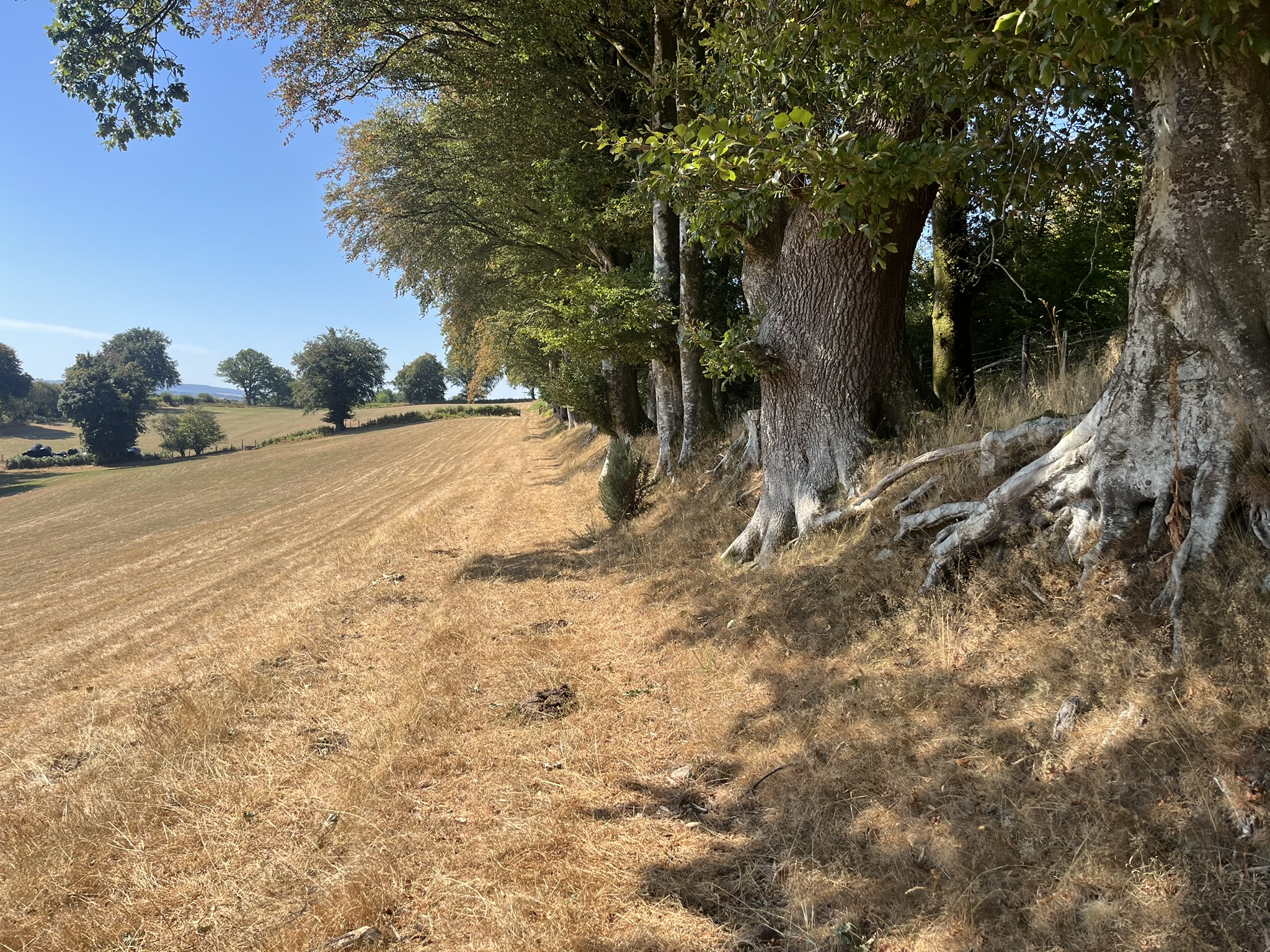
I don’t linger here, but take the Lampeter road, leaving it almost straight away for a path uphill through fields to a wood, Allt Parc-y-neuadd. This is sweaty work, and the steep gradient inside the wood makes things worse. I emerge at the top, panting and overheated, to find myself in the middle of a curious settlement, Cefnfoelallt, complete with ancient caravan, house, wild garden, sheds and assorted paraphernalia. From here a narrow road leads west, coming to an end at Penlan Goetre, another intriguing house. A track continues ahead, to run along the edge of Long Wood, looked after by a local community organisation. The line of the wood is marked by giant beeches, their smooth, silvery trunks glistening in the sun. Half way along I’m taking a water break, sitting like a gnome on a tree stump, when a middle-aged man suddenly appears. He’s a runner and has a phone strapped to his upper arm. We exchange experiences. He says that though he was born not far away he’s never been in this place before, and he shows me photos on his phone of life-size wooden statues to be seen in the wood’s interior. Then he resumes his run and is soon out of sight.

Further along the wood-edge path an oval-shaped ‘bulge’ in its line comes into sight. This is Castell Goetre, the second ‘hillfort’ of the Trail. It’s been ploughed and otherwise mistreated over the years, but seems to have had two defensive rings in its later phase, and you can still see some of its rampart stones. Less than a mile further on is a second, similar hill fort, Castell Allt-goch, again oval in shape and again later extended in size. Strangely, a Roman practice camp, traces of which were revealed by aerial photography, lie nearby.
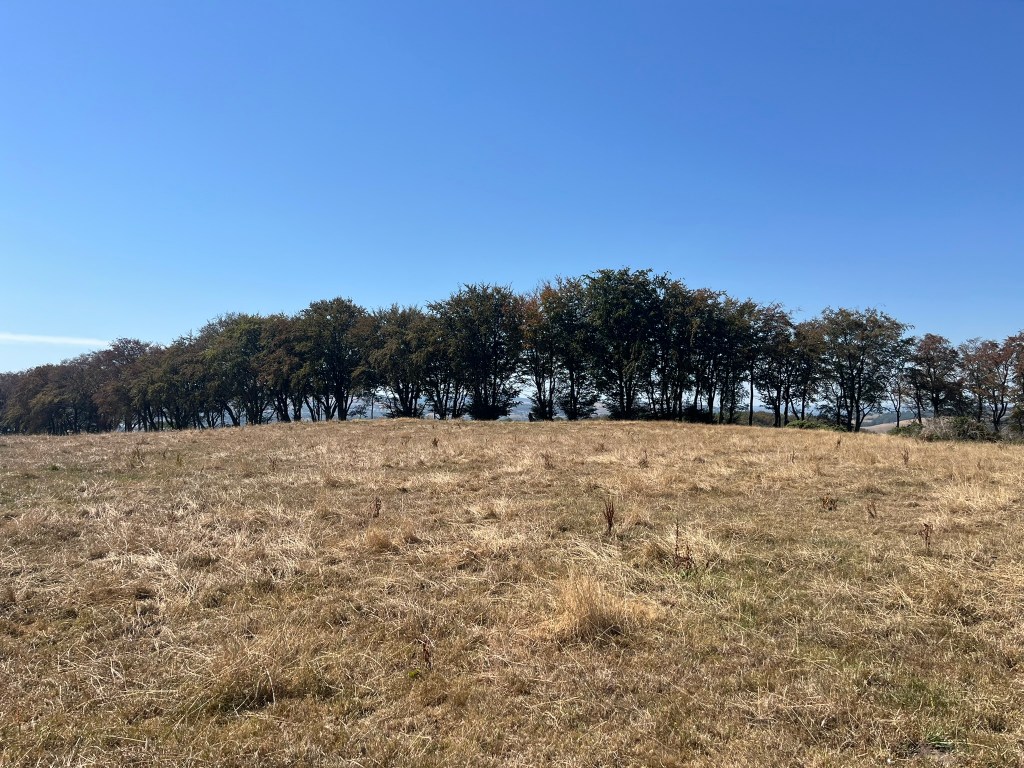
After this Iron Age tour the Trail joins a single row of stately beeches and then becomes a straight path moving towards the corner of a separate wood, Coed Olwen. In the final field a beech trunk has been sawn into giant wooden coins. They lie as they fell, like the disarticulated vertebrae of a bare skeleton. The path skirts Coed Olwen but then dives into another wood. Here dead leaves make for a rare sensation of softness underfoot, though fallen trunks obscure the route and I need to tack to my right. Emerging from this unfamiliar gloom, the path avoids Mount Pleasant Farm and drops via a farm track to a lane that leads towards Lampeter rugby club. It crosses Afon Dulas, where a large heron stands at the edge of a pool, motionless. So motionless that at first I’m convinced that it’s a statue of a heron. As I approach the statue comes alive. The heron shakes off its torpor and takes languidly to the air, to find a new station, somewhere more secluded. All that’s left is for me to walk down to the centre of Lampeter, past the buildings of St David’s College, founded in 1822 and the first modern university institution in Wales to be closed down.

This has been the hottest of the three days, and a short day, in distance (just nine miles) and in time: it’s still not one o’clock and the T1 bus will be here soon. But it’s introduced me to places I’ve never been to before, and with luck it won’t be long before I’m back in Lampeter for Days 4 and 5 of the Trail.

On the Carmarthen bus I get out my copy of The narrow road to the deep north for the last time. After reading the final page I go back to the book’s famous first paragraph, where Bashō writes:
Days and months are travellers of eternity. So are the years that pass by. Those who steer a boat across the sea, or drive a horse over the earth till they succumb to the weight of years, spend every minute of their lives travelling. There are a great number of ancients, too, who died on the road. I myself have been temped for a long time by the cloud-moving wind – filled with a strong desire to wander.
Bashō seems to have expected not to return from his long journey north – he sold his house before setting out – but in fact he did succeed in returning home to Edo. He never lost the urge to wander, and in 1691 set out on a trip to the far south of Japan. Surely he must be the true patron saint of the long-distance walker?


Leave a Reply