An old wall in an old house. On the wallpaper, a design of leaves, their greenness fading as reflected light strikes the wall. A twin electrical socket and a black plug, from which a connector box hangs by a cord. From the box another black cord falls into a loop via a tangled knot, then rises vertically towards the ceiling. A large rectangular panel is propped on a chair seat against the wall. Its painted surface has been stripped, irregularly, to reveal lighter patches beneath. Imprinted on it are the outlines of two rectangular shapes, maybe the ghosts of picture frames. To the right, a vertical strip of canvas, detached from its original backing and frame, its edges torn and its nail-holes showing; on it, the painted image of a stag, a Monarch of the Glen, faded by age and light to varying tones of brown. In the thin strip between the wall edge and an interior door, silvery sunlight floods towards us from the world outside.

This photograph – like all the works in the show, it has no title – belongs to the latest in a programme of work that Peter Finnemore has been engaged on continuously for forty years, possibly the most constant and concentrated programme maintained by any artist in Wales in recent times. It amounts to a never-ending dream-conversation with Gwendraeth House, the ancestral home of his family in the Gwendraeth valley. Along with a host of other works – photographs, paintings, sculptured surfaces, found objects and more – it’s to be seen now in the Glynn Vivian Art Gallery, in a show called ‘Silvers of space’. (It’s easy to misread the title as ‘Slivers of space’.)

Walls listen, and they speak, as Peter said in a gallery talk on 13 November, and that’s the premise of the argument he builds throughout the exhibition. A house is a home, a place of memory, a haunting. Over decades, even centuries, a wall slowly absorbs the sounds, sights and smells of the lives lived in the spaces it limits. Peter aims to release the traces of those lives the wall has witnessed over so long a period, in part by scraping back the paint and patina on the surface to allow the voices of the past to be heard. In the photograph time is peeled back in stages. The chair and the shaft of bright sunlight belong to the present, the electrics to the fairly recent past, the faded wallpaper to a rather earlier period. The board takes us further back, maybe, as the different layers suggest, two generations: the painting was made by Peter’s great uncle, Sidney Finnemore, and bears the date 1914.

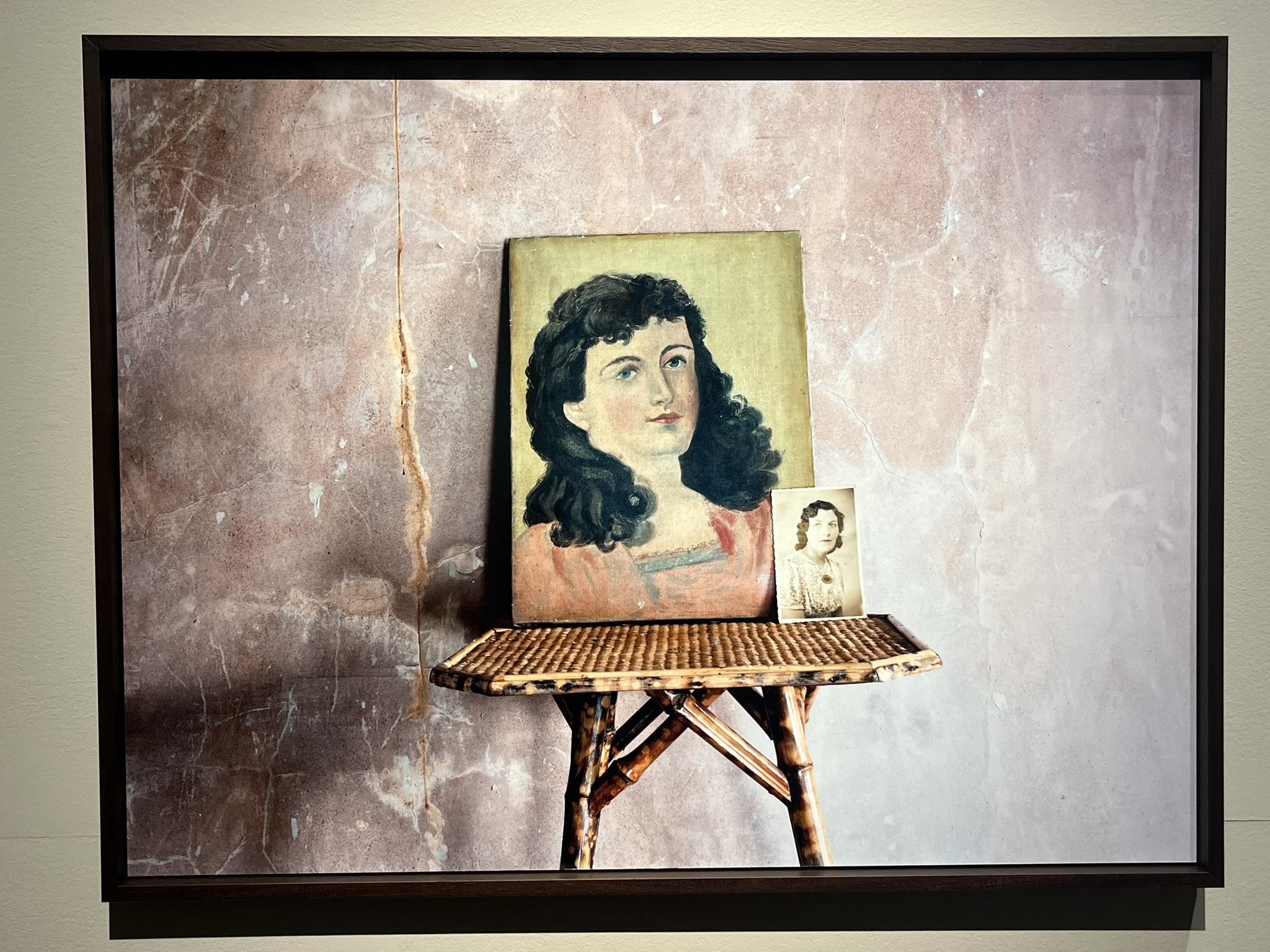
Other photographs explore similar territory. A portrait of another Finnemore rests on a bamboo table against a bare, cracked plaster wall, alongside a small black-and white photo of the same woman. Other photos feature frames, again propped against walls, and within them photographs of forgotten figures fading by stages to invisibility. Another shows part of an upright piano, again with ancient wallpaper behind. Here the sounds of the past emanating from the room are made explicit: a sheet of printed music, with sections obliterated, sits on its stand, and three white keys are depressed. By contrast, in another image, all sounds and all traces of the palimpsest of the past have vanished in a blue rectangle scrubbed to white: it reminds you of a Rothko painting.

All this might suggest, as I heard someone at the gallery talk say, that Peter is a kind of archaeologist, burrowing through debris to uncover the hidden remains of material life. But on reflection I don’t think this is quite right. Archaeologists – unless they happen to be Arthur Evans at Knossos – are destroyers, and, however poetic they may be, the result of their work is essentially data. Peter, though, is concerned to create as well as commemorate, to take what is left in Gwendraeth House and give it new life in new work, in what he calls ‘poetic areas beyond straightforward documentation’. Photographs are a favoured means of doing this – in the collaboration here with the writer and artist Mark Durden – but he also uses collage, textured painting and realia. These media give him the chance to explore what’s strongly present in the photographs but frustratingly two-dimensional – the sensation of touch. They restore the complex jumble of ancient surfaces in the photographs to the present, and give them new life.

Great-uncle Sidney was an amateur artist, and also a house-painter and decorator, as were other members of the family. Peter pays tribute to them through incorporating the fragments and relics of their work into this own. In so doing he questions the traditional hierarchies, still alive today, that separate painting as fine art from painting as pastime and painting as trade. One of Sidney’s attic-retrieved paintings, a Victorian-derived image of a seated girl, is propped up on the galley floor, while a photograph on the wall ‘elevates’ it to ‘fine art object’. This and other conversations across time lend dignity to the mundane, and restore lost labour and art to be admired by new generations.

Elevation of the everyday isn’t a new concern of artists, and some of the works on show here remind you of seventeenth-century Dutch paintings of interiors, with their meticulous, carefully rendered treatment of walls, doors and windows, and the light that animates them. The Dutch artists, though, were firmly rooted in the neat and the now, whereas Peter is more interested in the untidy past and its relation to the present.

In a glass case he has placed documentation as background to the art works: old family photos, paperwork of the old Finnemore painting and decorating business, and two copies of Cartrefi Cymru, a popular book first published in 1896, in which O.M. Edwards traced the lives and achievements of his personal heroes – not the conventional heroes of official culture – by seeking out and exploring their modest childhood homes. ‘Silvers of space’, it seems to me, belongs firmly to the Cartrefi Cymru tradition.

Peter has also curated a parallel Glynn Vivian exhibition, ‘Neighbours: borders, bodies, belonging’, which draws on historical and contemporary items from the Glynn Vivian, National Museum Wales and National Library of Wales, as well as private collections. Its choices and juxtapositions throw light on his own works. Peter riffs on the theme of walls and wall surfaces, starting in the eighteenth century with Thomas Jones’s bare, textured walls of Naples and ending with Sebastian Bruno’s contemporary photos of cracked walls in Merthyr Tydfil. Another theme, the centrality of home, is echoed in a photographic collage by Tom Wood, which includes Geoff Charles’s famous photo of the poet Carneddog and his wife Catrin saying farewell for the last time to their ancestral mountain farmhouse, and in a little-known painting from the Glynn Vivian’s collection, William Brooker’s The green divan, a mysteriously intimate, Vuillard-like image. Throughout, there’s a conversation between painting and photography and their differing approaches to places and people.

Home and belonging, the past and generational memory, space and light, and the marks made in them: these are big subjects. It’s little wonder that Peter Finnemore has spent so many years exploring them within the confines of a single small location. He thinks deeply about his art, and the result could have been drily conceptual and dull to the eye. Instead, this is collection of work, brilliantly arranged and lit by Glynn Vivian staff, that constantly asks you to engage your visual and tactile senses as well as your powers of analysis. Both exhibitions repay a visit, and pay back much more on a return visit.
Leave a Reply