Last month Douglas Dunn, one of Scotland’s leading poets, died aged 83. Like Philip Larkin he was a poet-librarian, and worked with Larkin in the Brynmor Jones Library at Hull University for a time (Larkin was encouraging and they shared a love of jazz, though politically they stood far apart). It was when he was living in Hull that he first made a mark with the socially engaged poems included in his 1969 book Terry Street. This was the first of several collections, but for many he’ll be best remembered for Elegies, published in 1985.

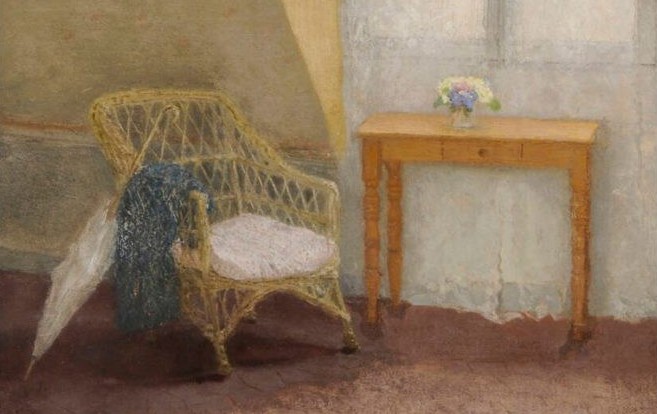
The thirty-nine poems in Elegies, varied in content and form, mourn and celebrate Dunn’s first wife, Lesley Balfour, who died of cancer in 1981, aged 37. They travel from diagnosis and illness to death, lamentation and memory. Balfour was a visual artist, and many of the poems draw on the links between word and image. Among them is a Shakespearean sonnet titled ‘Attics’, which summons up the distinctive, elusive paintings of Gwen John:
A room, unutterably feminine,
A room she dreamed, but painted by Gwen John –
I see a white-distempered attic in
Her mind, pastel, and faintly put-upon
By men, who cannot understand the light
From the window, lingering on the lace
Curtain’s folds, or the disturbing woman-white
Illumination on the mirror, almost a face.
A girl is sitting on a fragile chair
With her sad brushes and her thought, her hair
In tints of autumn, and her skin says, Kiss,
Kiss, kiss my skin, for I am touch and sense
Brushed womanly into this eloquence,
Unclothed in paint to teach you nakedness.

Here are three attics: the attic in Paris left to us by Gwen John in some of the most luminous paintings she made, the attic, ‘unutterably feminine’, dreamed by Lesley, and the attic as re-imagined by the poet. This isn’t an ekphrastic poem: there’s no single John work being called to mind. Instead, an amalgam of several: the two ‘empty room’ paintings (in Sheffield and Cardiff) and with their attic window, small table and ‘fragile’ wicker chair, and Girl reading at the window and La chambre sur la cour, where diaphanous lace curtains billow from the open window into the interior.

‘Unutterably feminine’ introduces the poem’s twin themes of silence and gender. Dunn starts to reconstruct the attic’s image before admitting that facets of it, like the varied subtleties of light on curtain and mirror, can’t be expressed in words – not only that, they lie beyond the understanding of a man. At the sonnet’s turn the painted girl and the real artist coalesce into the image of the figure in the chair, ‘with her sad brushes and her thoughts’ (a brilliant transferred epithet), who makes a direct, sensuous invitation to the poet, one that leaps across the gap between man and woman, between silent image and spoken word, to share an ‘eloquence’ of the body.

After ‘Attics’, the peoms journey beyond death and mourning to a gentler memorising, and a re-noticing of the suffering of others. In ‘Reading Pascal in the Lowlands’ the poet passes a boy dying of leukaemia (‘I do not tell him of my own sorrows. / He is bored with misery and premonition’). Perhaps the most painful, direct poems coincide with the immediate shock of loss, like ‘Home again’, a return to the shared house, neglected and silent now. ‘Fruit [in] good abundance, cold / in the palm of a hand’, from an earlier poem, ‘The butterfly house’, has decayed into a ‘cadaver orchard, an orphanage of pips, / four apples sink into a pulpy rust.’ Another echo is heard from ‘Attics’, where the light ‘lingering on the lace / Curtain’s folds’ has lost its grace:
The curtains dangle in a window-sway,
In window-cold. I touch their foliage,
Their textile, sympathetic park.

On the inside cover of my copy of Elegies I’ve written ‘Cardiff, August 1985’, so I must have bought it as soon as it was published. The book was obviously well-read. On the cover are what Dunn calls, in ‘A rediscovery of juvenilia’, ‘the Olympic rings of a coffee mug’. Curiously, in the margin of the text of ‘Attics’ a small hole has been pierced through the paper. The poem, maybe, left a special impression on me all those years ago.

Leave a Reply