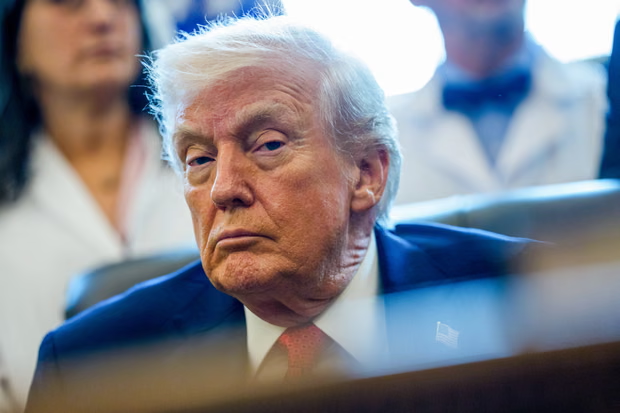
There’s been much talk, since Donald Trump kidnapped the President of Venezuela and declared that he would ‘run’ the country, of a reassertion of the Monroe Doctrine. This set me thinking about what exactly is or was the ‘Monro Doctrine’, and how it’s related to Trump’s actions.
To begin with, there’s something odd about linking the two words ‘Trump’ and ‘doctrine’. ‘Doctrine’ implies some important, well-based principle, whereas Trump is proverbial for acting on personal whim, caprice and prejudice. You wonder whether, if he was asked what the Monro Doctrine was, he would be able to give much of a reply. But let’s ignore that for the moment.
It turns out that the term ‘Monro Doctrine’ wasn’t in common use until the 1850s, decades after James Monro, the fifth President of the United States (1817-25) promulgated it in 1823. But it’s true that it was Monro, or rather his Secretary of State, John Quincy Adams (President 1825-29), who formulated the doctrine. The critical sentence in the document concerning it is this:
The occasion has been judged proper for asserting, as a principle in which the rights and interests of the United States are involved, that the American continents, by the free and independent condition which they have assumed and maintain, are henceforth not to be considered as subjects for future colonization by any European powers.

This statement falls some way short of later interpretations of the Doctrine. It seems defensive rather than an aggressive in its intent. Its focus is on the threat posed by the colonisers of the time – Spain, France and others – that they might reoccupy countries to the south of the US, most of which had recently gained their independence. This sort of action, Monro maintained, would be ‘dangerous to our peace and safety’. At the time the US lacked the military and economic capacity to enforce the principle, and the European powers were mainly scornful of its announcement.
Towards the end of the nineteenth century, though, as the might of its economy and armed forces increased, and in the wake of its geographical expansion westwards and southwards – constantly adding new territory through purchase, bribery and violence – the US grew capable of policing its own, unilateral Doctrine. Now it was in a position to impose its will, not only on colonising states but also on independent countries, intervening, economically or militarily, whenever it felt it was acting was in its own interest. And so the Monro Doctrine came to mean the ability to interfere in any way in any other country in the western hemisphere, which together formed ‘America’s backyard’. In the twentieth century almost every Latin American country, at one time or another, has been invaded by the US or has suffered ‘regime change’, directly or indirectly, at its hands.
One the key moments in this transition of the Doctrine from rhetoric to reality was an episode known as the Venezuela Crisis of 1895. It featured one of the main colonising powers of the period – Britain.

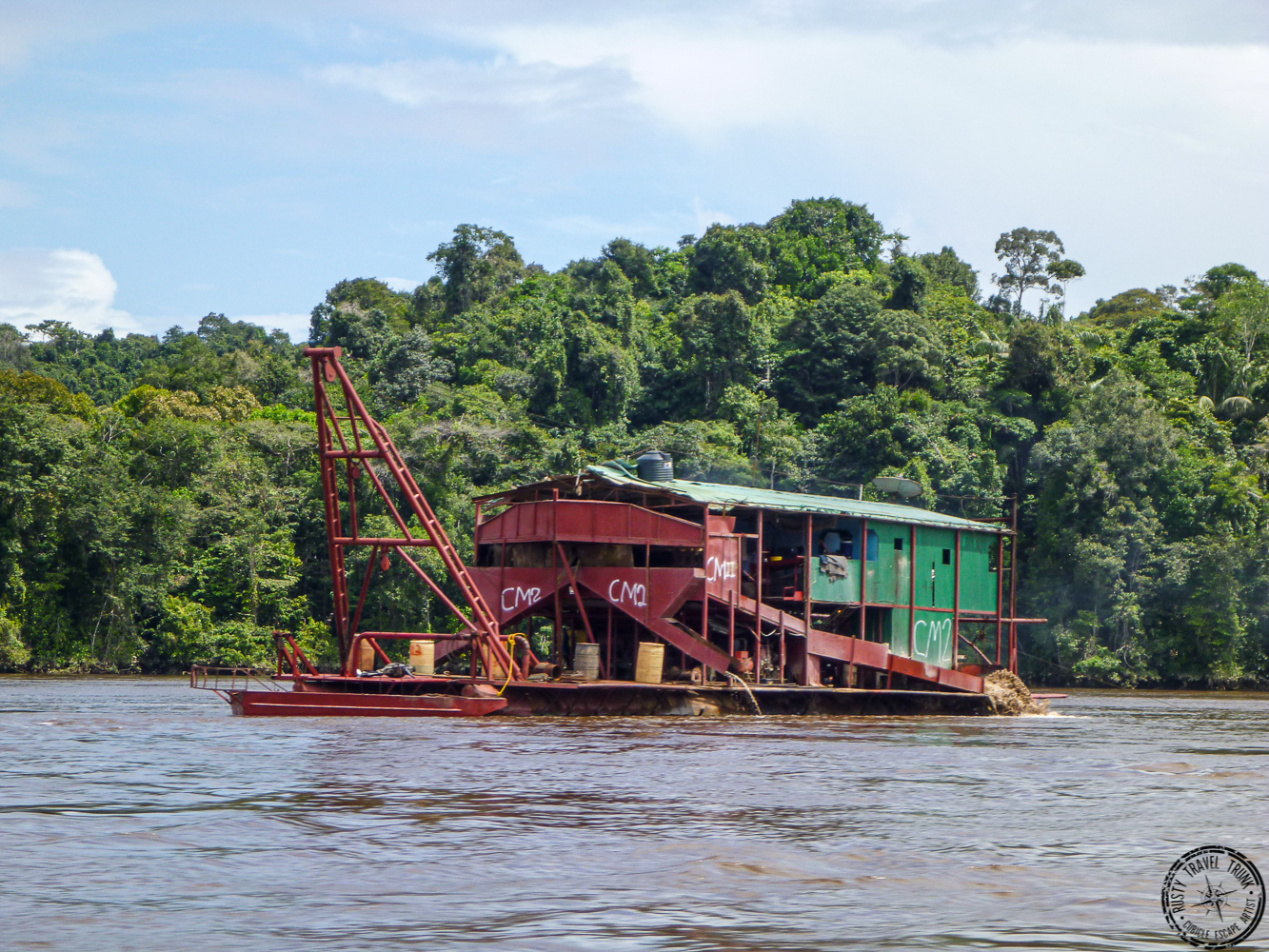
The crisis arose from a long-standing land dispute between Britain, which owned British Guiana, and Venezuela, which had finally gained its full independence from Spain in 1830. It concerned a strip of land called Essequibo. Each country claimed it as its own. The issue mattered because Essequibo was known to be rich in gold, the nineteenth century equivalent of crude oil.
By 1894 the dispute had already lasted fifty years. Then the Venezuelan government employed a lobbyist, William Lindsay Scruggs, who leant on the US government, publishing a pamphlet called British aggressions in Venezuela, or the Monroe Doctrine on trial. The Americans were open to Scruggs’s pressure, and in July 1895 the Secretary of State, Richard Olney, sent a letter to London saying, ‘today the United States is practically sovereign on this continent, and its fiat is law upon the subjects to which it confines its interposition.’ Eventually the British government caved in, agreeing that the US did have a right to intervene and that the British were willing to go to arbitration on the land dispute. The tribunal, which included US representation, sat in Paris and issued its judgement in October 1899.
Though the tribunal’s reasoning was never made clear, the outcome was that Britain was awarded 95% of the disputed land – a happy result for the colonial power. But, more important, a major European power had conceded that the US had the right to intervene decisively in south American affairs. For the US, after the Venezuelan crisis, there was no turning back. From now on, in Theodore Roosevelt’s words, they would ‘speak softly and carry a big stick’ throughout the Americas.

Donald Trump is doing nothing new or particularly shocking, then, in sweeping aside the leadership of the Venezuelan government. There are precedents too many to list, and the Monro Doctrine, antiquated though it may be as an undead monster of nineteenth-century imperialism, still lives today. There is one difference, though. Monro’s original statement conceded that the US would not interfere in European affairs. This reservation no longer applies in the Trump era. The US government is clearly unafraid to threaten and attack Europe, as the Greenland demands show.
The ‘Donro Doctrine’ turns out to be no more than a shambolic sequence of foreign adventures, uninformed by any thought for the consequences, and unchecked by restraining influences (‘I don’t need international law … my own morality, my own mind, it’s the only thing that can stop me’). So far from being the isolationist he was supposed to be, Trump seems happy to bomb and bully his way round the Americas and the rest of the world (including, to date, Iran and Nigeria). Though he’s careful not to take on directly his fellow neo-imperialist world powers, Russia and China. We’ve now reached, at last, the arrangement of the world imagined by George Orwell in 1984, power being shared by three massive (ostensibly warring) totalitarian blocs, Eurasia, Oceania and Eastasia.
Leave a Reply