I’d arranged to meet a friend, H., for breakfast in the Black Lion in Pontrhydfendigaid, but she rang to say that, because of her asthma she’d need to stay indoors at home in the morning to avoid inhaling the wildfire smoke. So I make an early start, pass through the village, cross the Teifi bridge and turn down Lisburn Road, past a large house mural and a red dragon reading a book, into a series of flattish fields.

The crops have been cut and baled, and the stubbled earth rings hollow under my boots. I misread the guidebook and in the last field find myself cornered, with no exit. Back on track, and after a farm, I follow the path downhill. Two buzzards are calling to each other to my right, and ahead of me stonechats click their electric clicks. Already rush beds are invading the fields, a sign that Cors Caron (Tregaron Bog) isn’t far ahead.

The path joins the track of the old Carmarthen to Aberystwyth railway line as it crosses Cors Caron, the most complete example of an upland bog in Britain. Walking along its straight course, for over a mile, is a melancholy experience. Richard Beeching closed the line in 1965, severing the only north-south Welsh link between the north and south of the country. At the time, I suppose, Wales was barely seen as a distinct country by those in power, and political power was something not possessed by Welsh people (only a little has changed since). If the line had survived, and seen a fraction of the investment of what’s gone into other transport projects, what a difference it might have made to the fortunes of places like Tregaron, Lampeter and Llanybydder. I remember reading how in 1866 the promoter of this section of the line, David Davies Llandinam, encouraged his engineers to invent a new way of laying track over bog, using willow and hazel branches, and sheep wool, and industrial slag and ash.

As I walk I’m glad of the shade cast by the trees overhanging the track, even though they’re clearly struggling in the drought. The leaves of the willows are already yellow and withering. Fallen leaves float on a rare wayside watercourse. I wonder how other plants, and animals and insects, dependent on the cool, wet conditions of the bog, are suffering in the dried-out conditions. Even the nettles look stringy and weak. Only a few plants enjoy the heat: sow thistles, for example, and rosebay willowherb, whose seeds blow like smoke across the track. The birds have fallen silent, though I disturb a buzzard; it takes off with the arrogance of an RAF jet along the track ahead.

The Trail leaves the railway track at Maes-llyn and climbs to the south. At Treflyn I blunder into an odd scene: a Polish woman, staying in a holiday cottage nearby, is on the point of presenting the cottage’s owner with a gift, a large tray of thick apple slices. She offers me one. Then she asks me, in an unexpectedly direct way, how old I am. When I tell her, she seems strangely impressed that I should be tackling the whole of the Trail at my advanced age. I politely decline her cake offer: I tell her I prefer to travel light.

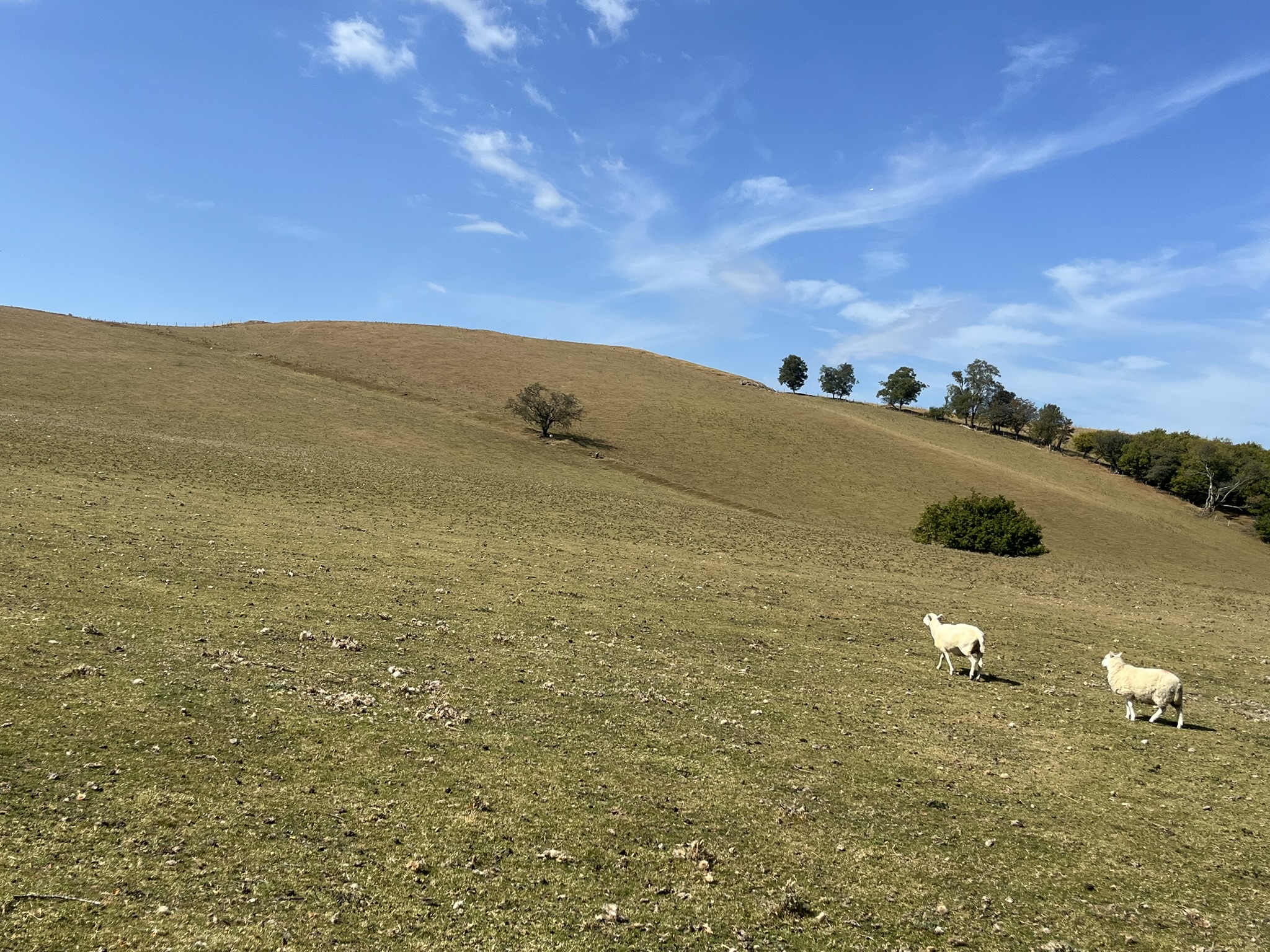
The path climbs further, and so does the temperature. The fields up here look like deserts. They’re so sun-blasted that even the sheep have forsaken them. The only advantage of coming this way is the fine view back across Cors Caron, and beyond to stationary windmills on the hills to the north. At a farm I’m surprised to see apple trees loaded with red fruit. I could carry on downhill, but the heat is now so intense that I need to take a break in the shade of a tall communications mast. Further down towards the valley floor birdsong resumes: nuthatches, coal tits and bluetits, blackcaps and robins. I’m now on a narrow farm road, and step aside to let a truck pass. The driver winds down his window and we exchange words. He’s a farmer, who looks after the farm I’ve just passed, Bryn-y-gog, though he rents it out (‘dim dewis arall gen i, nage?). He himself welcomes Trail walkers, though he says the farmer further up the hill, maybe the one with the apple trees, is hostile. (The long-distance walker is well used to occasional farmer-friction.)

At the bottom the farm road deposits you on the fast B4343, and there’s an uncomfortable stretch of road walking till you reach a pavement on the outskirts of Tregaron. I feel by now I’ve deserved a proper snack and call in at the excellent bank-turned-café, Halen a pupur, for a panini, several pints of water and a decent rest. After that, my water bottles refilled, the strenuous climbing resumes through fields, then along a minor road. It’s a long pull up the hot tarmac. At the top, Tregaron disappears from view behind me, and to my left I can see the hills closing in on the single-track road over the mountains to Abergwesyn.

At Llidiart Coch I stop to let a truck pass. The driver winds down his window. It’s the same farmer I met earlier. He tells me he’s on his way to his own farm – Bryn-y-gog belongs to his father – and assures me that he’s not stalking me. ‘Tan y tro nesaf …’, I reply, though I don’t see him again. Next, I turn off the road on that the guidebook calls a ‘muddy farm track’: today it’s bone-dry, of course. I pass a ruined farmhouse and continue down a sunken lane. A farmer is ploughing the field to my left, lifting clouds of powdered earth that billow across my path, filling my eyes and throat with small particles. Past Pencefn Drysgol farm there’s a descent to dried-up Nant Carfan along an avenue of fine mature beeches. Beyond is the long parallel line of the Cambrian foothills, dark with heather.

Next comes a long descent on a narrow tarmac lane, past farms, Cwm-du, Gwyngoed-fawr and Gwyngoed-fach. I’m looking for a water-stop and somewhere to sit, but the hedges continue unbroken on either side, so in the end I get out my bum-pad and sit down in the road. The chance of passing traffic is small, and I’m desperate. Restored, I can face the last descent into the village of Llanddewi Brefi: the path leaves the lane and crosses fields to join Afon Brefi and emerge at the bridge.

Llanddewi Brefi isn’t over-large but it’s made up of an intricate web of lanes, with roads leading out in seven directions. Once it was a busy, self-sufficient community, with many inns and shops (the last remaining shop has now closed). Its large church, with powerful tower, sits on a rise, said to be the product of a miracle performed for Dewi Sant as he was preaching at the Synod of Brefi in around 550, after his audience was unable to hear his words. What the village does have is a pub, the New Inn, my home for the night. The owner, Y., cooks me a meal, in addition to serving pints at the bar – she runs everything single-handed. I ask her about the Teifi Valley Trail. She tells me that many walkers stay with her, some from the UK, but many, too, from northern Europe.

There are more people than usual out and about this evening, I suspect, since the near-total eclipse of the sun is expected around 7:20pm. People spill out of the pub into the street. Wandering round the village I spot people carrying devices for indirectly viewing the eclipse, including a colander and a Weetabix box. Then by chance I meet an engineer, a sort of White Knight who’s invented his own powerful helmet-cum-visor for viewing the sun. He lends it to me, and I get to share the stunning effect of the moon darkening most of the sun’s circle. (All the more stunning because I’m unlikely to be around to see the next ‘deep partial’ solar eclipse, in 2050).

The excitement subsides, and I go and sit in the square below the church, outside the other, part-time pub in the village, not open today, the Foelallt Arms. Dozens of swallows sprint across the sky above the buildings of the square, snatching insects from the warm currents before launching themselves into the higher air. I open my copy of Bashō’s The narrow road to the deep north and read from where I left off yesterday. At the city of Sendai, Bashō writes, an artist gives him a pair of straw sandals dyed blue with iris. Touched by the gift, he weaves them into a poem, an emblem, perhaps, of the beauty of walking:
It looks as if
Iris flowers had bloomed
On my feet –
Sandals laced with blue.
Another summer poem evokes Bashō’s characteristic sense of the transience of things:
A thicket of summer grass
Is all that remains
Of the dreams and ambitions
Of ancient warriors.
My room at the New Inn is spotlessly clean, but seventeenth century Japanese accommodation couldn’t always provide the highest standards. Here is Bashō, in comedic vein, after a night in the gatekeeper’s house at the barrier-gate of Shitomae:
Bitten by fleas and lice
I slept in a bed,
A horse urinating all the time
Close to my pillow.


Leave a Reply