There’s a blustery, cruel wind from the south-east, whipping along the streets and making the eyes water. As T.H. Parry-Williams wrote in ‘Gwynt y Dwyrain’ (The east wind), it seems to carry a message:
Gan lorio marwolion ar ei hynt
I ddangos i ddynion beth yw gwyntFlooring mortals that way and this
To show humanity what wind is.
I’m on my way to the Mission Gallery to the opening of a show with the apt title ‘Gwynt Traed y Meirw / The Wind from the Feet of the Dead’.

The artist is Nigel Hurlstone. He lives and works in Ffynnongroyw, Flintshire, and he’s known mainly for his work (and teaching) in textiles. But he ranges widely, and this exhibition encompasses photography, performance and short stories as well as the most intricate and skilful embroidery. The show was first staged in the Ruthin Craft Centre. It’s been cut down in size to fit the intimate chapel-space of the Mission, but that hasn’t reduced its impact. Or rather impacts: as you walk round the space, as you’re intended to, in a clockwise direction, you move from laughter to disquiet to horror.
‘Gwynt Traed y Meirw’ had its beginnings in lengthy hospital stays (Nigel suffers from a rare lung disease). This enforced institutionalisation, with its loss of personal agency and strange new social interactions, together with the effects of powerful medication, stirred childhood memories and strange hallucinations.

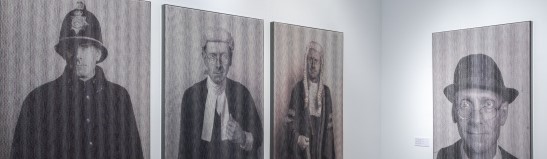
Each image on the wall features the figure of Nigel himself, photographed by Dewi Tannatt Lloyd. Each image is printed on to a cotton background, which is then partially obscured by faint vertical screens of embroidered textile. The result is eerie: as you walk slowly past one of the figures it seems to shift slightly and echo your movement. In his gallery talk Nigel explained that the effect he was aiming to replicate was the experience of watching an old black-and-white television, where the ‘hold’ button was sometimes needed to correct an image beginning to slip off-screen.
The auto-images divide into three blocks. In the first, Nigel ‘dresses up’, assuming the clothes of various characters from the 1950s, 1960s and 1970s films and television series that appealed to him so much when he was growing up: a policeman (Dixon of Dock Green), a barrister (Rumpole of the Bailey), a pilot, a jockey, a vicar, and so on. In the second series there’s a partial undressing, stripping the social protection of uniforms and revealing a much more vulnerable figure. A further stage is the figure as ghost, shrouded in thin fabric.

On the final wall, the undressing reaches its finale. Accompanied by a last character self-portrait, a top-hatted undertaker, is a shocking, four metre long, multi-panel image of Nigel as corpse, lying on a mortuary slab. Here the model isn’t a jovial one, like the stock figures from childhood films. It’s Hans Holbein’s painting of the 1520s The body of the dead Christ in the tomb, a work familiar to Nigel from his youth. This picture is often treated as hyperrealist, although in fact Holbein injects an exaggerated drama into Christ’s head and hand. Nigel’s remaking of the scene as all the more powerful for being prosaic and understated (except for his elongated middle finder that points upwards as a sign of distaste for death). Such a fate, as he said in his talk, was one of the possible outcomes of his hospital stay. This time, the embroidered layer seems to act as the screen modern society habitually uses to protect us from the fact of death.

As I looked at these works (and their title) I couldn’t help recalling J. Kitchener Davies’s famous pryddest or long poem ‘Sŵn y gwynt sy’n chwythu’ (Sound of the wind that’s blowing), the product of a hospital stay and the heightened consciousness of a patient in extremis, looking back from his bed, with startling honesty, on his childhood and past life:
Heddiw
Daeth awel fain fel nodwydd syring,
Oer, fel ether-meth ar groen,
I chwibanu am y berth â mi.Today a cold wind like the needle of a syringe, cold like ether on the skin, came and whistled on the other side of the hedge.
In the gallery you can sit in an armchair and listen to four audio pieces, ‘Live a little longer’. They’re dramatized short stories, prepared by Steve Doherty and written by Nigel on the basis of his hospital experience. Here is the patient, not as introspective hallucinator, but as spiky and touching observer of the hospital staff, relatives and fellow-sufferers. One of the pieces, entitled ‘Ganymede’, cup-bearer of the gods, concerns Bernard’s insistence on being prescribed Ambrosia custard on the ward. The characters we meet take us back to the ‘dressed up’ characters of the first self-portraits in the exhibition.

‘Gwynt Traed y Meirw’ is an exhibition almost made for its current home. The Mission’s mission is to give a stage to those who insist on the link between art and the careful crafting of art – and, as in Nigel’s case – forms of art beyond the visual.
I left the Mission feeling I’d been granted a short but privileged look into a stranger’s mind: playful, multifaceted and more than usually alive to the harsh reality of things. Outside, the wind from the east was still blowing hard, chilling the feet of Swansea’s dead.
‘Gwynt traed y meirw: the east wind (lit. the wind of dead men’s feet, referring to the custom of burying the dead with their feet pointing eastwards).’ [Geiriadur Prifysgol Cymru]
Nigel Hurlstone’s exhibition ‘Gwynt Traed y Meirw / Wind from the Feet of the Dead’ is on at the Mission Gallery, Swansea until 4 April 2026.
Leave a Reply