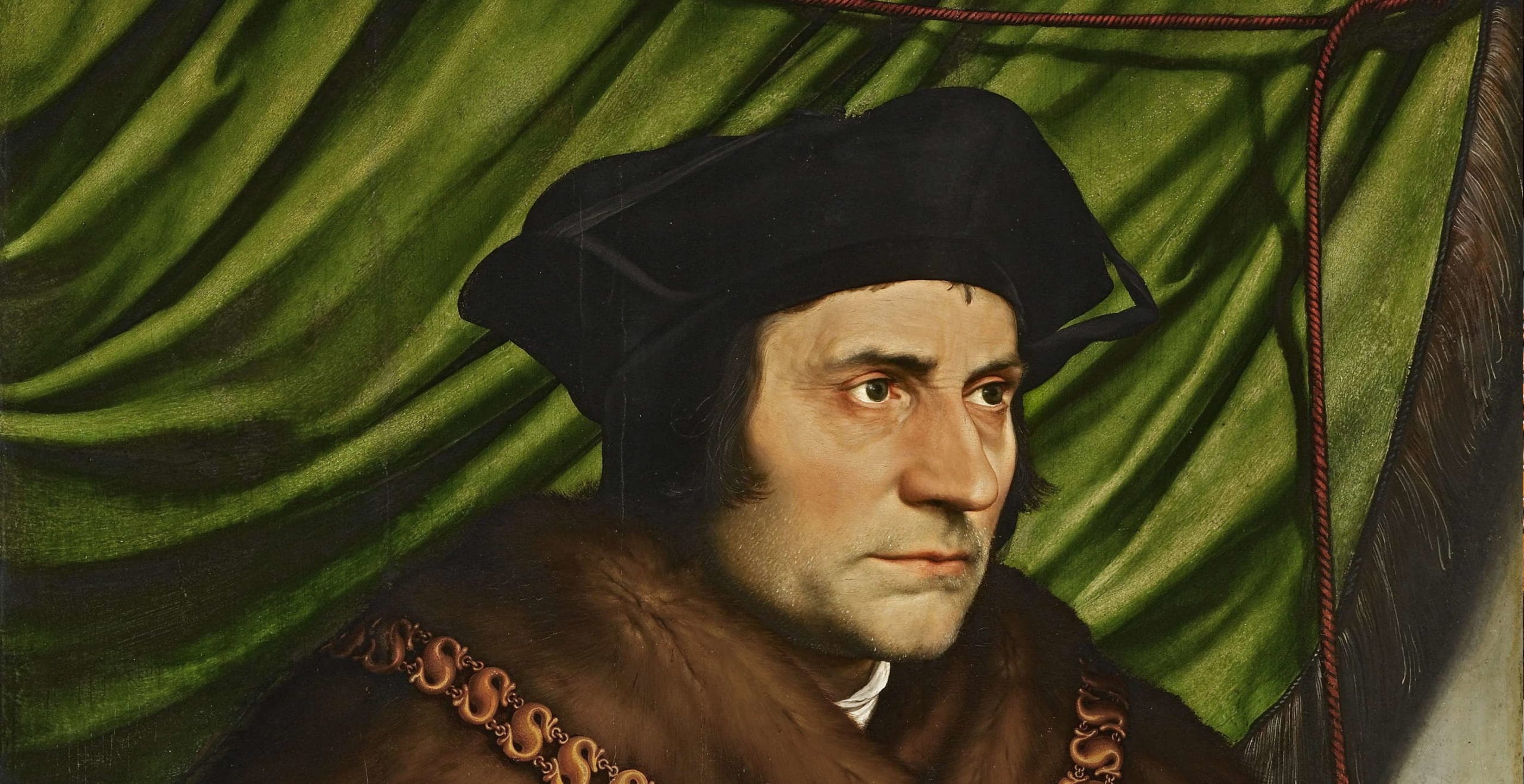
I’m not sure why it’s taken me so long to read Thomas More’s Utopia, first published in Latin in Leuven/Louvain in December 1516. It’s certainly one of those books you wish you’d discovered long ago. But 2026 isn’t a bad year to think about utopian worlds, at a time when we’re faced with so many dystopian ones, factual and fictional.

The two words ‘utopia’ and dystopia’ aren’t antonyms. ‘Dystopia’ is certainly used to describe a nightmare world of the future, like Aldous Huxley’s Brave new world, Yevgeny Zamyatin’s We or George Orwell’s 1984. But the other word, ‘utopia’, has its origin in the Greek ‘ou-topia’ (no-world) rather than ‘eu-topia’ (ideal world) – simply, a world that doesn’t (yet) exist. It’s not entirely clear that Thomas More the author, let alone ‘Thomas More’ the character in his book, agrees with Raphael, the narrator of the story of the island and its inhabitants, that Utopia really is a society far in advance of any existing state.
Raphael’s account of Utopia is embedded in a background debate between friends, set in a garden in Antwerp. This framing device introduces ambiguity, leaving the reader to wonder what More intends by Utopia. My own sense is that its astonishing ideological and social system is one that More saw as his ideal, the outcome of applying the New Testament teachings of Christ to a complete society. At the same time, though, he knew, since ‘we are where we are’, it was unlikely ever to be realised – that it was ‘utopian’ in the word’s current, sceptical connotation. In addition, the ambiguity allowed to deflect attacks from opponents on the more challenging aspects of Utopian society, like voluntary euthanasia.

What you can’t deny, though, is how bold and imaginative is More’s vision of his Utopia. Its state is a democracy, of sorts. Everyone works, usually on the land, but enjoys leisure time for intellectual pursuits. War is avoided, and treaties too, since Utopians depend on good faith in others. Most are Christians, but all practice religious toleration. Personal riches are scorned. Above all, no one owns private property. All land and other goods are owned communally: ‘no one is poor or reduced to begging, and while nobody possesses anything, everyone is rich.’
For Utopians, societies based on greed and private enrichment are not to be envied. Raphael ends his account by contrasting Utopia with currently existing political systems, where:
… the rich are forever fleecing the poor of some of their daily pittance, not only by private fraud but even by official legislation … when I survey all the different political systems flourishing today, nothing else presents itself – God help me – but a conspiracy of the rich, who look after their own interests under the name and title of the commonwealth.
This could have been written yesterday, not in 1516. As Terry Eagleton wrote almost half a millennium later,
… one of Utopia’s most striking aspects is its contemporaneity – the way in which the greedy, unscrupulous and useless are just as much in evidence now as in 1516. The conspiracy of the rich has lasted an extraordinarily long time.
But the description of Utopia occupies only Book 2 of More’s work. Book 1 consists of a debate on a different topic, one which is just as relevant today as it was in More’s age: whether or not those with social ideals should ally themselves with the holders of political power.

The theme is introduced by Peter Giles, one of the others present in More’s garden (and a real person: an Antwerp magistrate and, like More and his friend Erasmus, one of the new ‘humanists’):
I wonder, my dear Raphael, that you don’t attach yourself to some king. For I can’t think of a single one by whom you wouldn’t be most welcome, seeing that with your learning and your experience of places and people you’re equipped not only to divert him but also to instruct him with examples and guide him with counsel. By the same token, you would promote your own interests and prove a support to your relatives and friends.
Raphael will have none of this. He has no need to benefit his own friends and relations, and regards service as no more than servitude. More counters by appealing to his social conscience, insisting that by entering the service of a king Raphael would be able to ‘direct him … towards just and honourable actions’. This won’t do either. Most kings, says Raphael, are too intent on conquest and expanding their territories rather than on governing well, and don’t take well to wise advice (as opposed to the flattery of sycophantic courtiers). Undaunted, More perseveres in his argument:
Your friend Plato holds that commonwealths will only be happy when either philosophers rule or rulers philosophise: how remote happiness must appear when philosophers won’t even deign to share their thoughts with kings.
Raphael replies that kings have been so warped and corrupted since childhood that a philosopher would have little chance of eradicating the sources of evil in them. Granted that kings aren’t perfect, More says, isn’t it better to take a more tactful, indirect route and do what you can to alter the king’s behaviour in a way which does least harm? No, responds Raphael, that just means that you have to compromise your principles, constantly lie, and lose your reputation as an honest adviser.

The debate is left unresolved. More the author, however, had already decided which side he was on. The trip to Antwerp really happened. More had travelled there as part of an official delegation to negotiate a trading agreement, at the behest of ‘the most invincible Henry, King of England and eighth of that name, a prince richly endowed with all the qualities of an outstanding ruler’, in the words of the first sentence of Utopia. From that time he became ever closer to the Trump-like figure of Henry VIII, until, in 1529, he was appointed Lord Chancellor.
Compromise and necessity took him very far from the kinds of principles he’d outlined in Book 2 of Utopia. For example, far from showing religious toleration like the inhabitants of Utopia, he was an uncompromising Catholic and hot in his pursuit of heretics. Even if accusations that he tortured Protestants can’t be substantiated, he supervised the execution of a number of them. And of course, Raphael was proved right that advising monarchs can be harmful to the adviser. Following Henry’s break with Rome More fell out badly with him over his Catholicism, refusing to acknowledge him as head of the church. Henry accused him of treason and he lost his head in 1535.
Whether it’s wise for people of principle to throw in their lot with rulers in the hope of influencing their direction towards beneficial goals is still a live issue today.
Leave a Reply