The first thing you do, as soon as your book is published, is wonder what you’ve missed out. (That’s not quite true; the first thing is start looking for possible typos that have escaped the editing eye.) In the case of Cader Idris and the artists (and its twin, Cader Idris a’r artistiaid), I began to think, ‘Have I omitted artists of importance who’ve tried to capture Cader Idris?’

One early artist comes to mind quite readily. His younger brother Cornelius has a whole ten images to himself, and a whole chapter of text. John Varley, on the other hand, has no pictures and only a few passing mentions in the text. And yet in his day, and even now, he has a much more recognisable name as a landscape painter than Cornelius. He’s also known as a collaborator with William Blake on his famous ‘visionary heads’. And he did come and paint Cader several times.

John Varley was born in Hackney in 1778 and was trained as a painter in London. In 1798 or 1799 he visited north Wales, returning in 1800 and 1802, and quickly developed a taste for painting landscapes in Eryri. He was a prolific producer of watercolours, and had many pupils and followers, to judge from the number of ‘after John Varley’ attributions. Among the painters he taught were other ‘Cader painters’ like Copley Fielding and David Cox. As well as teaching he published a number of guides to painting, including, in 1816-17, a manual called A Treatise on the Principles of Landscape Design, and John Varley’s list of colours (1816). John’s three brothers, including Cornelius, all became painters, as did his daughter Elizabeth, who married yet another painter, William Mulready.

Another of William Blake’s friends, John Linnell, painted an oil portrait of Varley in 1820. He looks a tough sort, and Linnell, in his autobiography, describes him as ‘bull like in strength and figure’ (he was an amateur boxer) and ‘a man of the most generous impulses … but deficient in sagacity and most easily imposed upon by the crafty.’ Yet another pupil, Elizabeth Turner, wrote that ‘he unites a more childish simplicity and credulity, and he entirely believes in astrology, palmistry, raising of ghosts and seeing of visions’. It was the visions that brought him into contact with William Blake, and the two of them collaborated on the ‘visionary heads’ or real and imaginary figures they produced between 1819 and 1825.

Varley was an active organiser of artists. In 1804 he helped set up the Society of Painters in Watercolours. At its first exhibition he showed as many as forty-two paintings, and averaged forty-four in the years up to 1812. He sold many, but he seems to had no head for business, and when watercolour painting fell from fashion he found life hard. In 1820 he was declared bankrupt and had a spell in prison. Despite an artistic revival in later years, he died in relative poverty in London in 1842. Obituarists recognised Varley’s skill, but his reputation was overshadowed by what his biographer calls the ‘monotony of his vast output’.

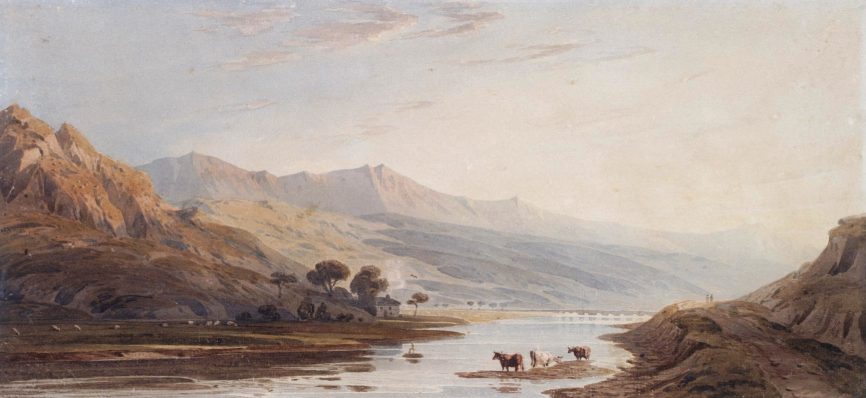
Cader Idris appears in several of Varley’s early landscapes (most of them remain in private hands). His style at this period was heavily influenced by Richard Wilson and Wilson’s Italianate models, and there’s little in them that you could claim was distinctively Varleyan. Worse, Varley takes many liberties with the topography of the mountain, and you’d find it hard to navigate in the real landscape with the help of any of his works. In effect, though his titles are specific enough, these are ideal mountain landscapes rather than studies resulting form keen-eyed observation. This makes them completely different from the works of his brother Cornelius, whose sketches of the north face of Cader Idris are both meticulous in their observation and luminous in their concern to capture light and texture in land and sky. While his brother was dabbling in the mysteries of astrology and phrenology, Cornelius continued his lifelong fascination with light and optical technologies.

So, should I have included in the book a John Varley landscape of Cader Idris? Possibly, if I’d been setting out to be representative. But not at the expense of his brother. Cornelius, even though few people know about him, is a more unusual artist. He didn’t use the mountain as fodder for commonplace landscapes but scrutinised it carefully and sensitively, from different angles and under different conditions of weather and atmosphere, to create his own, distinctive Cader Idris.


Leave a Reply