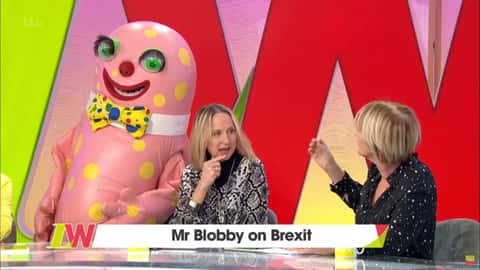
I must admit, I hadn’t noticed that Mr Blobby had made a comeback. Not, that is, till reading a newspaper article about him a few weeks ago. It seems that he’s come out of relative obscurity during the last few months to terrorise the studios of chat shows and other television programmes, by breaking objects and furniture and crushing guests in his stifling embrace.

Some of you will remember that Mr Blobby first came to prominence on Noel’s house party, an inexplicably popular show that ran for nine years on BBC1. This was a vehicle, until its cancellation in 1999, for an ex-DJ with big hair called Noel Edmonds. When it folded, Edmonds claimed, in Trumpian mode, that ‘history will prove that House Party was one of the most successful entertainment shows of all time.’ The show consisted of various regular features and games, including one called ‘Cash for Questions’. Mr Blobby was added to the cast in 1992. He was supposed to be a character who’d escaped from a children’s TV series, and his role was to irritate star guests and stem declining ratings.

For those of you unfamiliar with him, Mr Blobby is a creature made of plastic. He has a bulbous pink plastic body, swollen legs and arms and puffy fingers – all of them blotched, as by an infectious disease, with yellow spots. He’s unclothed, except for a spotty bow-tie. His large head comes with a large, fixed, lipsticked leer, and green eyes that swivel maniacally. His linguistic abilities are rudimentary (‘blobby’ or ‘blob’, uttered in an electrionic, Daleky tone, are his only comprehensible words) but he can move his large body swiftly, usually with destructive force, against any person or things he takes against. It’s rumoured that beneath Mr Blobby is a person – for his first twenty years, a Shakespearean actor from Bradford, Barry Killerby. But perhaps this was a vain attempt to humanise an essentially inhuman creation.

Mr Blobby quickly made a name for himself. He was invited as a guest on many other television programmes, to create mayhem and break things. He had a hit record in 1993 with the single My Blobby, often ranked as the worst Christmas song of all time (Mr Blobby the album, released in the following year, was voted the worst LP ever). He has his own YouTube channel, several lines in merchandise, and was once the chief attraction in a financially disastrous ‘Mr Blobbyland’ theme park in Morecambe. Few nowadays remember Noel Edmonds, but Mr Blobby is instantly recognisable.

Strangely, he isn’t universally popular. It’s a cliché that British humour doesn’t travel well across the Atlantic, but Americans seem to find him horrifying or impossible to fathom. According to the New York Times, ‘some commentators have called him a metaphor for a nation gone soft in the head. Others have seen him as proof of Britain’s deep-seated attraction to trash.’ (That last sentence is a bit rich, coming from the US.) A couple of years ago another (presumably) American wrote on Reddit to enquire:
I am not British, but I watch some British TV shows and I recently discovered Mr. Blobby. So my question is What the hell is Mr. Blobby? Is it popular? Does it have cult status? Is it for kids? All I know is that it terrifies me.
Highbrows also find him hard to take. Here’s Matthew Sweet, radio intellectual and cultural historian (I’m assuming that his tongue isn’t in his cheek here):
Mr Blobby is a creation of breathtaking stupidity. His stupid name, his stupid appearance, his stupid voice and its ceaseless repetition of his own stupid name are unimaginative to the point of atavism. Somehow, his dumb relentlessness has allowed him to push through into some other territory. Maybe his blundering, lobotomised qualities strike a chord in a world that’s commonly said to be getting more stupid.
Criticisms like these miss the point. The point is that Mr Blobby is anarchy personified, a sower of chaos. This isn’t his first revival, it’s just the latest in a long series of embodiments of the principle of radical disorder, part of an old Europe-wide cultural tradition. We tend to think that violent anarchism went out of fashion with Peter Kropotkin and Joseph Conrad’s Mr Verloc, but Mr Blobby proves that it’s an undercurrent that’s still in flow. Anarchy and leftism, though, are no longer linked together. We still bear the recent scars of Boris Johnson, the most anarchic if not anarchistic of UK prime ministers. You could say the current exponents are the anti-democratic California tech bros. The motto of Mark Zuckerburg’s Facebook used to be ‘move fast and break it’ – exactly the personal ideology of Mr Blobby.

Further back, types of clowning and commedia dell’arte have always included a disruptive, subversive and sometimes frightening element, and still further back many cultures have had traditions of turning the established order upside down, like the Romans’ Saturnalia, the French Feast of Fools and the English Lord of Misrule. Perhaps the closest forerunner of Mr Blobby is the German folk character Till Eulenspiegel (‘Till Owl-Mirror’), a scatological trickster who pokes fun at the hypocrisies of society. Disorder, subversion, laughter and threat, symbolised in Mr Blobby’s case by his fixed and sinister grin, are a common combination.
So maybe trepidation is the right response if you find yourself too close to Mr Blobby in the television studio. He’s a formidable force – and, far from being a symbol of the degeneracy of contemporary society, he stands as its nemesis.
Leave a Reply