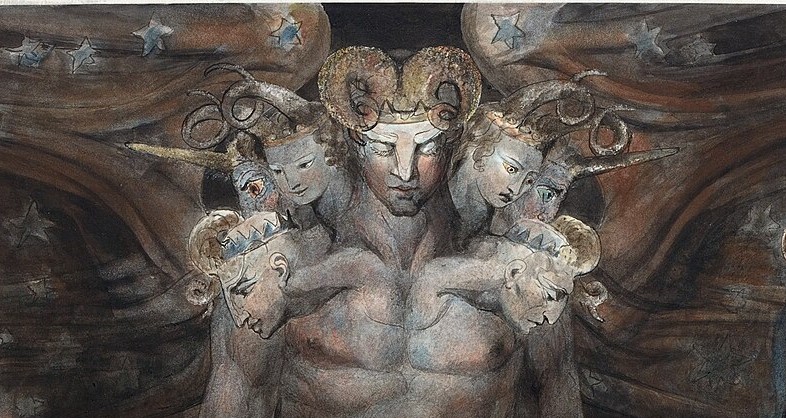
The Christadelphians of Mount Zion, whose events often provoke strange thoughts, are inviting us to join them for an eight-week seminar course called ‘Understanding Armageddon’. Like most people, I suppose, I had a vague idea about Armageddon, but I began to wonder exactly what it was, how it arose, and how discussion about it might occupy eight whole sessions.

Armageddon, I discovered, is an exceptionally thin concept. It has no connection with the gospel teachings or conversations of Christ, and could justly be described as an unChristian idea. The word occurs only once in the Bible, in that strange, hallucinatory document called the Book of Revelation, sometimes ascribed to St John of Patmos – a book that was squeezed into the New Testament very late in the day, in the fourth century (some Eastern Orthodox churches don’t recognize it as scripture). This is the relevant passage, in the language of the King James Bible:
And I saw three unclean spirits like frogs come out of the mouth of the dragon, and out of the mouth of the beast, and out of the mouth of the false prophet. For they are the spirits of devils, working miracles, which go forth unto the kings of the earth and of the whole world, to gather them to the battle of that great day of God Almighty. Behold, I come as a thief. Blessed is he that watcheth, and keepeth his garments, lest he walk naked, and they see his shame. And he gathered them together into a place called in the Hebrew tongue Armageddon. And the seventh angel poured out his vial into the air; and there came a great voice out of the temple of heaven, from the throne, saying, It is done. And there were voices, and thunders, and lightnings; and there was a great earthquake, such as was not since men were upon the earth, so mighty an earthquake, and so great. And the great city was divided into three parts, and the cities of the nations fell: and great Babylon came in remembrance before God, to give unto her the cup of the wine of the fierceness of his wrath.
Ἁρμαγεδών, the koine Greek word in the text, stands in for the Hebrew הַר מְגִדּוֹ, or Har Məgīddō, ‘Mount Megiddo’. Tel Megiddo is a real place, a much-excavated Bronze and Iron Age fortified city in the Jezreel valley, near Haifa in modern-day Israel. The author of the Revelation, though, seems to treat Armageddon as a symbol rather than a specific location. Making sense of the passage is a hard task, but in general ‘Armageddon’ seems to be the site of a final ‘battle’ in which God defeats, with extreme violence, the massed forces of evil, including the red dragon Satan. Following God’s victory, Christ returns in glory.

John was probably writing at the time of Roman military campaigns against the Jews, towards the end of the first century CE. His intention, scholars think, was to buttress Jewish morale, at a particularly difficult and oppressive time for them. What he wasn’t trying to do was predict the end of the world in the far future. And yet this is precisely how later generations, reading the Book of Revelation, have interpreted Armageddon and its aftermath, as an ‘apocalypse’ in the modern sense (John uses the word in its literal sense, an uncovering of divine mysteries). As the Christadelphians say, ‘Discover how Bible prophecy has predicted the rise and fall of world empires – and reveals the events leading to the greatest turning point in human history. If the Bible really reveals what the future holds, wouldn’t you want to know?’
In more recent times, ‘Armageddon’ has enjoyed several revivals – during the Cold War, when exchanges of nuclear weapons threatened ‘mutually assured destruction’ (MAD), and today, when climate catastrophe and the destruction of nature again promise an end to our world. Christadelphians and other fundamentalist sects don’t need an external, real-world threat. They believe in a literal ‘final battle’, and welcome it for what follows it, the Kingdom of God.

It’s surprising that the misunderstanding of a single, passing reference in a peripheral Christian text should have given rise to such a strong tradition of religious (and non-religious) thought. On the other hand, John’s vivid, extreme language, his heady symbolism and his insistence on the finality of a battle between good and evil have always held an appeal for those seeking simple, violent and triumphant solutions to complex problems.
As Naomi Klein and Astra Taylor have written, Armageddon and ‘end times’ are especially attractive to the (exclusively male) evangelical tech billionaires who have such a sinister hold on our lives today. Peter Thiel, the owner of the data engineering company Palantir, often talks incoherently about the ‘antichrist’ (a Revelation theme) and seems to believe that the end of the world is fast approaching. In one lecture he says, ‘I’m a libertarian, or a classical liberal, who deviates in one minor detail, where I’m worried about the antichrist.’ The antichrist, for Thiel, is an evil amalgam of international bodies, like the UN and the International Criminal Court, climate change activists, Bill Gates and advocates of the legal regulation of AI. Elon Musk’s obsession with setting up colonies on Mars stems in part from a similar fear that nuclear Armageddon is likely to obliterate the earth. Other luminaries are making personal preparations for the final battle. Mark Zuckerberg long ago built a remote hideaway for himself on the Pacific island of Kauai (Thiel had plans, now abandoned, for a similar bunker in New Zealand).

These same people, and other AI promoters, now find themselves confessing that artificial intelligence ‘agents’ may develop uncontrolled destructive tendencies, and even put an end to the human race. Sam Altman, boss of OpenAI, has said, in the usual semi-literate way of tech bros, ‘I think AI will probably, most likely, sort of lead to the end of the world. Though maybe ‘confess’ isn’t quite the right word, since some of this tribe, ‘transhumanists’, apparently look forward to a post-human future and the eclipse of people by cyborgs and computer-uploaded brains.
What’s the best way for lesser mortals to react to these dire, god-like predictions? Maybe, to begin with, by refusing to indulge in talk about Armageddon and ‘end times’. The tech billionaires have a vested interest in getting the rest of us to believe that the course of history – including the triumph of their own creations – is an inevitability. As long as we believe, on the contrary, that they are not gods controlling our lives, the way lies open to curbing their power, through government regulation of the uses of AI, and through action by ordinary people angered by their unaccountable actions, including their imposition of giant, parasitical AI datacentres on local communities.
One thing the tech end-timers value about the imminence of Armageddon is that it will rid the world of the worthless majority of the population. Only the select few, like themselves, will survive to live in the new world. They are self-confessed elitists, and will sometimes openly admit, like Peter Thiel, to being anti-democratic. Here too they need to be challenged and faced down.
In short, Armageddon needs to be put back into its magic box, alongside the other crazed notions of John of Patmos and his followers. Instead, we should concentration our attention on improving the current world rather than fantasising, like the tech bros and the Christadelphians, about its violent end and replacement by a new world.
Leave a Reply