It’s taken four bus rides, via Swansea, Port Talbot and Pontrhydyfen, but by ten o’clock I’ve reached the visitor centre at Afan Argoed, where C. and I ended Day 7 in July 2024. I can’t really explain why it’s taken over a year and a half to reconnect with St Illtud. The weather’s often been poor – but not, I have to admit, for the whole of that time.

Anyway, here I am at last, minus C. this time. Already the Lycra’d and helmeted bike trailers are limbering up, testing their brakes and gears before taking to the hills. I wonder whether I’ll meet them later, but they have other, more challenging routes to tackle. I only come across a couple of solo cyclists – and no other walkers at all – in the twelve and a half miles across the heights to Margam.

I can’t complain about today’s weather. It’s warmish for late March, cloudy and still – ideal for walking up a long hill. The path resumes behind the South Wales Miners Museum, up a broad stony track between high banks that turns into a grassy trail as it climbs towards the woods ahead. The gradient’s generous to ageing joints. It takes an easy route round the flank of Cefn yr Argoed, and then skirts the fringe of the first of the many coniferous plantations I’ll meet during the day. The trees are dark and close-planted, and seem empty of signs of other natural life, including birdsong. (I discover that later forests aren’t entirely lifeless, and I hear chaffinches, blackbirds and even a song thrush.)

The path levels off on after the climb. The first of many invisible skylarks sing overhead. Some of the going is boggy and puddly – after the winter rains, the ground’s still saturated – but soon I’m inside the plantation, on broad, well-made forest tracks. At first this a relief. You can look about you on this surface, without having to concentrate on where the next boot will land. But the tracks continue for miles. Before long, your eyes begin to tire of gazing at conifers, and the feet to ache on the unrelenting straight tracks. Drainage work at the side has disturbed some of the way-markers, and at a bend I go astray, fail to take a minor path to the left, and have to plod back (I’d forgotten to check the Ordnance Survey app’s red arrow).

In her book Wanderlust Rebecca Solnit has a wonderful paragraph about the ideal state of mind that walking induces, a state in which ‘the mind, the body and the world are aligned’, so that we can feel ‘in our bodies and in the world without being made busy by them.’ As you slog along these forestry tracks, that fine balance between mind and world gets disturbed. Faced with an unceasing line of trees, and lacking the longer, more varied views that the eye desires, your mind turns in upon itself, and gloomy, existential questions start to loom.

The only minor relief from the forest comes when the living trees give way to dead ones. As so often, clearance leaves a violent wilderness of torn trunks and disordered heaps of branches, so that the scene resembles some First World War battlefield.
Finally the conifers give way to stunted deciduous trees and the path turns west and begins to descend, joining what looks like the straight, level track of an old tramway. Ahead is the old pit village of Bryn. The path passes through what is now the Tomen y Bryn nature reserve but was once the Cefn y Bryn colliery and its spoil tips. Nothing remains of either: the mine closed in 1935 (another pit, the Bryn Navigation, closed in 1964). In the village, only the hulk of the Royal Oak pub remains to remind you of the giant thirst of coalminers.

Next, the path climbs again, eastwards and back into the woods. Miles more tramping along forestry tracks follow, towards Mynydd Margam. Very occasionally distant views open of Maesteg, lying below in the Llynfi valley. Much of the going is uphill, culminating in a long straight stretch that tests the mind and the muscles. I pass the memorial stone to W.H. (‘Billy’) Vaughan of Taibach, a railway guard and trade unionist for most this life, who devoted his spare time to distinguished public service in many spheres, including forestry. Apart from Billy I see no other people, except for one speeding e-cyclist, and no surprises, except a pond containing brilliant yellow skunk cabbage flowers.

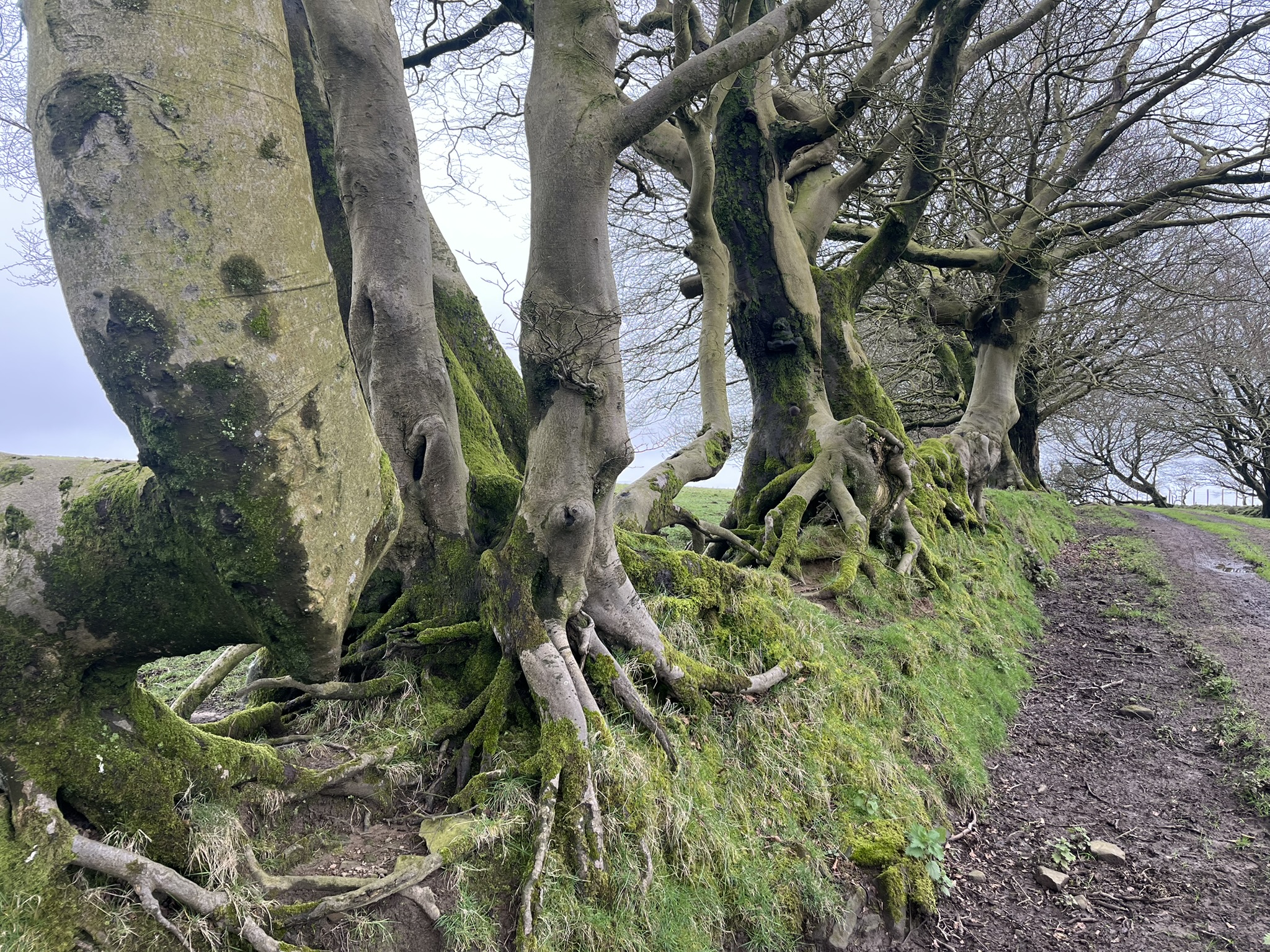
At length the path emerges into open country, to reach a confusing junction of tracks by a stream. Again, the way-markers are misleading or missing, and it takes a while to find the right way forward, up again between the edges of two woods marching in parallel. It grows colder, a breeze gets up, and a swirly mist descends for a time. Then, finally, I’m free of the forestry for good. The path starts to descend towards Margam, past a single row of ancient trees with twisted roots and trunks, and then as a sunken track. This is the best part of the day’s walk. Wide views open up, of the Port Talbot steelworks, Eglwys Nunydd reservoir and the sea beyond. Past a tall fence and gate I’m in the Margam Park deer park. To my right is a herd of browsing deer, well used to nearby humans. A few people are out strolling as the path make the final approach to Margam Castle. By the gate an explanatory board marks the end of St Illtud’s Walk.

I have a drink in the café, and then wander slowly past the Castle, the Temple of the Four Seasons, the Orangery and cherry trees in blossom, thinking that I’m in plenty of time to catch the X1 bus back to Swansea. But the times at the bus stop on the A48 are completely different from those I’ve pulled from First Cymru’s website. I’ve just missed the last bus to go by, and have to call Ca. to rescue me by car. While waiting for her, I visit the Abbey church and talk to one of the volunteers there, who’s arranging flowers for Easter. I ask her where all the flowers, and the floral skills, come from, and she replies that she used to be a florist.

On the way home we compensate for all the confusion with a Japanese meal in Swansea, a good way to celebrate the end of the St Illtud’s Walk – even if the 64 miles did take nearly three years.


Leave a Reply to ALAN RICHARDS Cancel reply