Dear Charlotte
A few months ago, in a second-hand bookshop in Tideswell, I came across a copy of your book Under another sky: journeys in Roman Britain. I bought it, and finally I’ve got round to reading it. I know I’m late to the table – you published the book in 2013. But I thought I should write, just to say how much I loved reading it.

Books that straddle genre boundaries are always intriguing. Yours is a mix of travelogue, biographical sketchbook, an outline of the Roman period in Britain, and a study of intellectual history over several centuries. What’s original about it is that you explore how the idea of Roman Britain has been invented and reinvented over the centuries since, by archaeologists and historians, myth-makers and fantasists, novelists and poets.
You descend like Aeneas to the underworld of the city of London, clump along the northern walls of Hadrian and Antoninus Pius, and find yourself in the ‘invisible city’ of Silchester without realising that you’re there. Sometimes you’re helped by Roger Wilson’s aged but unsurpassed guidebook to the Roman sites of Britain, which I loved when younger and still treasure. As you travel about the country in your old camper van, you introduce us to fascinating characters from the past who’ve helped to bring Roman Britain to life: archaeologists Mortimer and Tessa Wheeler, myth-makers like Geoffrey of Monmouth, the philosopher-archaeologist R.G. Collingwood, the forger Charles Bertram, the radical and fearless walker William Hutton and his brilliant daughter Catherine, the poet A.E Housman and the novelist Rosemary Sutcliff.

You raise, too, critical questions about how we might see the Romans in Britain, through the lenses of later generations and our own. Were the Romans violent imperialists and oppressors, or bringers of civilisation and comforts? Were the Britons crude, aggressive barbarians, or freedom-loving sophisticates with their distinctive culture and language? This conundrum was already present in the pages of the historian Tacitus. (We share a liking for his barbed, imaginative wit, and like me you’re drawn to the searing anti-imperialist speeches he puts into the mouths of Caratacus and Calgacus.) You share the story of the usurper-emperor Carausius, who sometimes gives the impression of being a proto-British nationalist, setting himself up in opposition to the imperial centre. (It’s a pity you missed the other ‘Carausius’, a name on a post-Roman stone in Penmachno, which suggests a continuing memory of the doomed would-be emperor.)
This dialectic about the nature of the Roman presence has echoed down the centuries, from apologists for Victoria’s great new empire to Howard Brenton and his powerful, denunciatory drama The Romans in Britain in 1980. It’s a heady mix you brew for us, and you serve it up to us in such easy but stylish language.

I know you don’t set out to give us a comprehensive picture of Roman Britain – though, if I can venture one criticism, your coverage tends to be a bit lop-sided in favour of southern England. In particular, you allot less than four pages of your book to Roman Wales. You do pay brief visits to Brecon Gaer and Caerleon, but your camper van doesn’t seem to have the energy to explore the interior beyond.
So I thought I’d end by offering a few of my own favourite Roman sites in Wales, in the hope that you might come back and include them in a second edition of your excellent book.
Venta Silurum is the main town in the south-east corner of Wales. It’s small but it has the best-preserved Roman town walls in the whole of Britain, as well as the foundations of houses, market place and temple. In the church is an inscription set up by the town council to ‘Paulinus’, who commanded the second legion at Caerleon and went on to be a provincial governor in Gaul. Cadw calls Caerwent a ‘well-kept secret’, and it’s usually a very quiet place.

Most visitors to Caernarfon will know its massive and oppressive Edwardian castle. Few make the trip up the hill to the outskirts of the town to see its imperial predecessor, the Roman fort of Segontium, first excavated by Mortimer Wheeler. Which is a pity, because the plan of (the later version) of the fort is clear, and you can trace the barrack blocks, the HQ building and the commandant’s house. (The site’s museum, alas, has never reopened.) Segontium was occupied until near the end of Roman rule, and lived on in medieval Welsh memory as Caer Aber Seint, in The dream of Macsen Wledig.
The Roman fort and town lie buried under the modern town (the oldest continuously occupied town in Wales), but beside the main road leading north-east from the centre visitors are sometimes surprised to come across the small amphitheatre, preserved from housing development in the 1940s by a vigilant borough surveyor. And if you’ve time in Carmarthen, don’t forget to call in at Carmarthenshire Museum in Abergwili, and its collection of Roman and post-Roman inscribed stones.

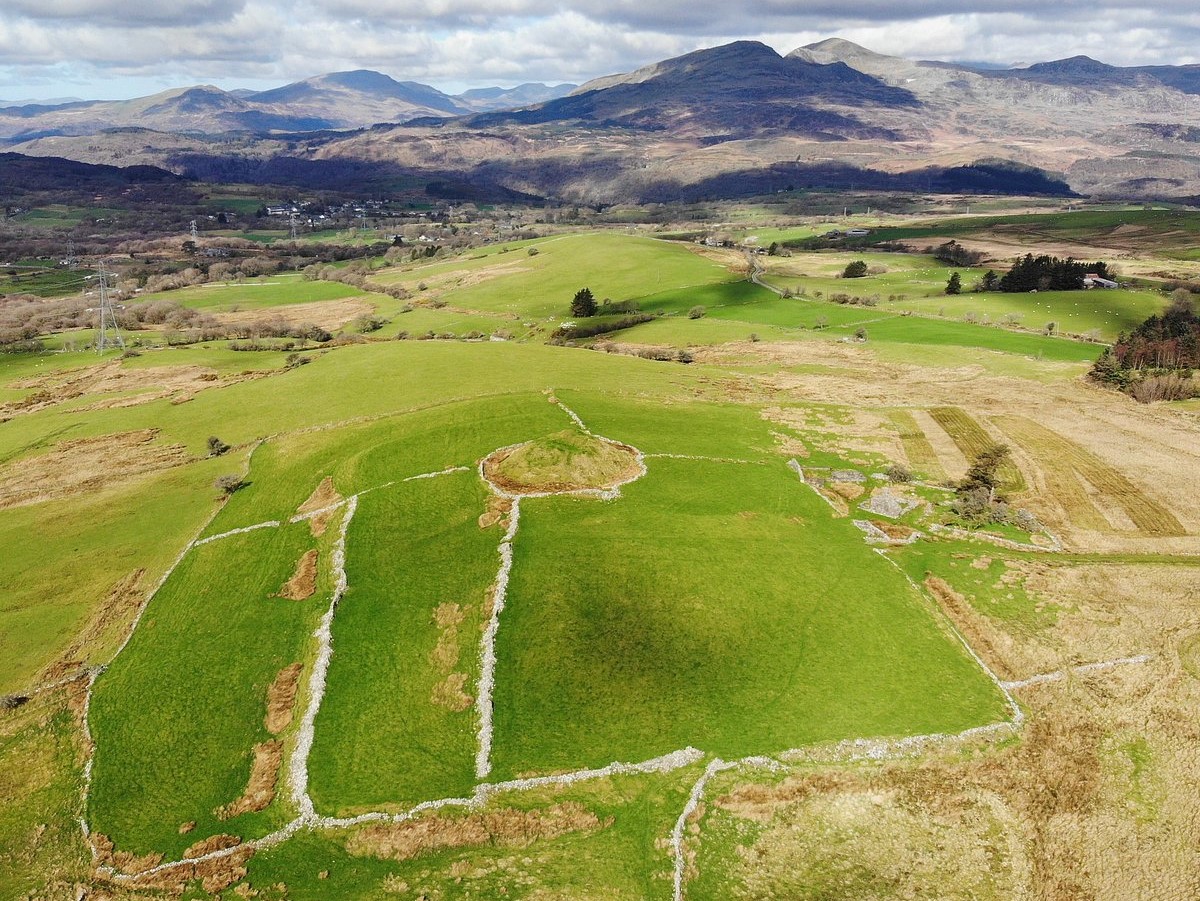
Another surprise. High in the wild, windswept hills near Trawsfynydd in Meirionnydd is the Roman fort of Tomen y Mur. It wasn’t occupied for very long, but the site includes a reconstructed corner of the fort, and a complex of buildings outside it, including, very unusually for a fort, a small amphitheatre, to occupy the troops in this remote place. In the centre of the fort is a strange intrusion, a circular motte thrown up by the early Norman invaders. A Roman road leads south towards the next fort at Brithdir.

The only Roman gold mine in Britain. It’s a complicated and confusing site, and it’s not easy to distinguish the Roman workings from later ones. Maybe the most impressive features are the long aqueducts, channels cut into hillsides that brought water flows from higher up the valley to wash the gold ore. Carreg Pumsaint survives as a huge stone used to crush ore. The fort that guarded the mine lies under Pumsaint village on the river Cothi nearby. Beautiful gold ornaments were discovered at Dolaucothi over two centuries ago: they’re now shared between the British Museum and Carmarthenshire Museum.
Leave your camper van at the Blaen Llia car park in Cwm Llia, north of Ystrafellte, walk uphill through the woodland (it conceals a Roman marching camp), and you’ll emerge on the Roman road linking the forts at Coelbren and Brecon Gaer. You can follow its clear course all the way to the ford across Afon Nedd Fechan. Soon after emerging from the trees you’ll notice on your left the tall inscribed stone commemorating Dervacius, son of Justus, a post-Roman big noise – a sign that the road was used long after Roman rule ended, by proto-Welsh people, some of whom used Latin. When you get home, Charlotte, you could read Tom Bullough’s fine book Sarn Helen, which traces the whole road, from Neath to the north coast.

At the end of your book you wonder when Roman Britain came to an end. The answer to that question depends, as you say, on what you mean by Roman Britain. After all, it wasn’t as if ‘the Romans’ left at the start of the fifth century and went back to Rome. Almost everyone was a Roman by then. You might, though, have looked beyond the Anglo-Saxons in England and considered what followed Rome in the other parts of the island.
But now I’m quibbling. If anyone’s looking for a book that doesn’t just present Roman Britain but also raises some fundamental questions about it, Under another sky is the place to start.
With best wishes,
Andrew Green.


Leave a Reply