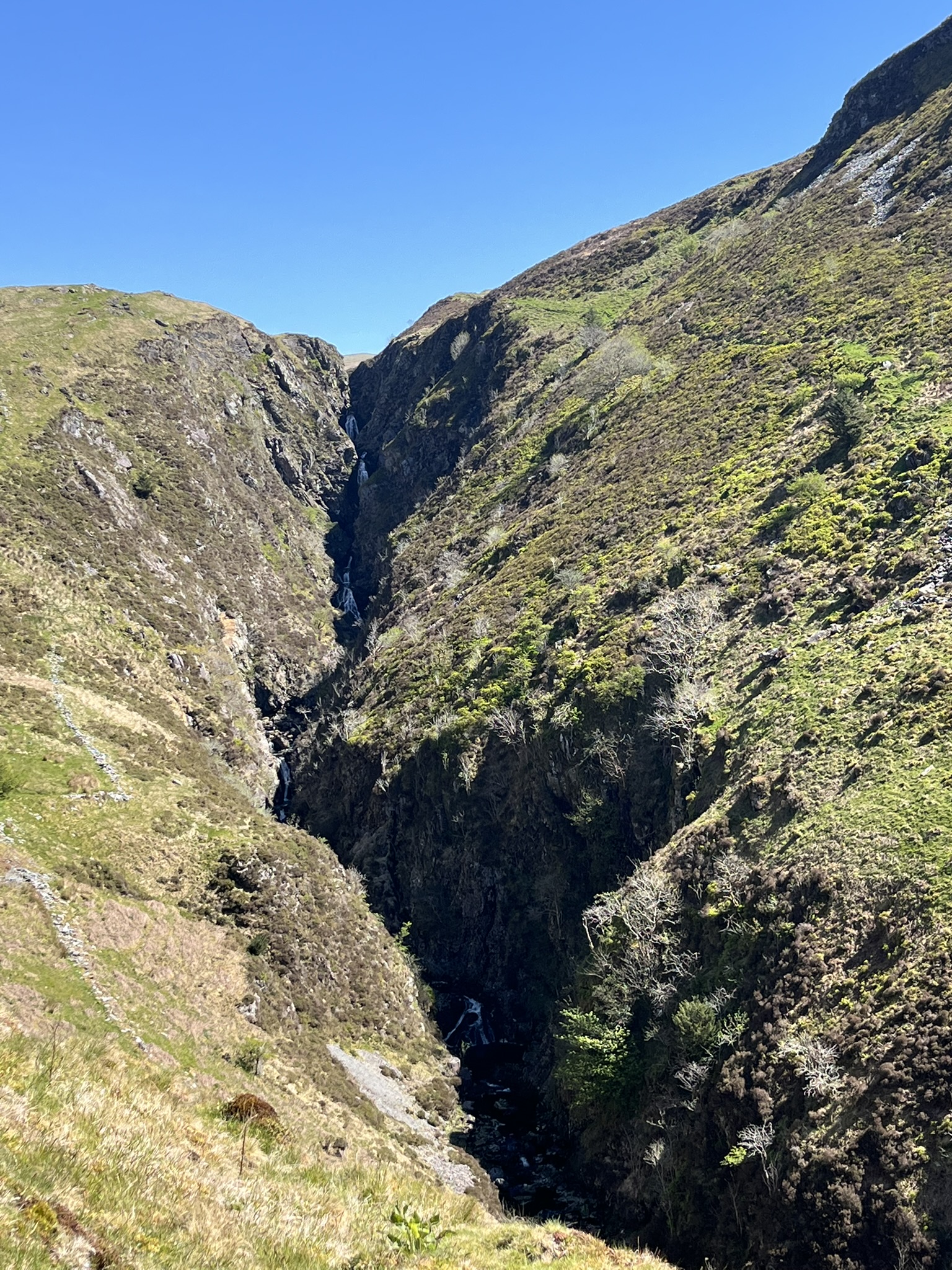
M has left us for Cardiff, so we’re now reduced to a trio. Our taxi turns up on time today, and takes us back to Llan Ffestiniog. We leave the village and drop down through fields to make for the Cynfal Falls, whose waters cut a gash of white though the dark stony ravine. The path then follows Afon Cynfal upstream, though steep banks of oak and beech woodland. The trees are only just in leaf, so the wood is bathed in a light green glow in the morning sunshine.

This riverside, Ceunant Cynfal, is what Natural Resources Wales, which cares for it, calls a ‘Welsh rainforest’ – normally, though not today, an oasis of dampness. Several rare mosses live here, and the stone walls wear fur coats of green. The river scores its way between huge rocks in a gorge far below us, with many cascades and waterfalls. We come across a group of helmeted jumpers launching themselves from rocks into deep, dark pools. The path winds its way up and down along the right bank for a couple of miles, until it emerges into open ground, still following the river.

For a while we follow a track just inside a plantation. Ominous mechanical sounds from foresters reach us from deep within. We recall our childhood readings of the Brother Grimm, whose stories often feature unpleasant happenings in dark forests. Suddenly C1 brushes past a small conifer branch, which whips fiercely across C2’s head, dislodging one of his hearing aids. It’s a camouflaged, grey-and-skin colour, and we spend fifteen minutes searching for it on the forest floor, scouring with twigs through the grass, moss and tree debris, in vain. C1 and I wonder quietly whether, for the rest of the journey, we’ll be reduced to keeping C2 to just one side of us when speaking to him. At length the tiny object comes to light, and we resume. By now a strong wind has sprung up, and the tall pine tops above us whistle and strain.
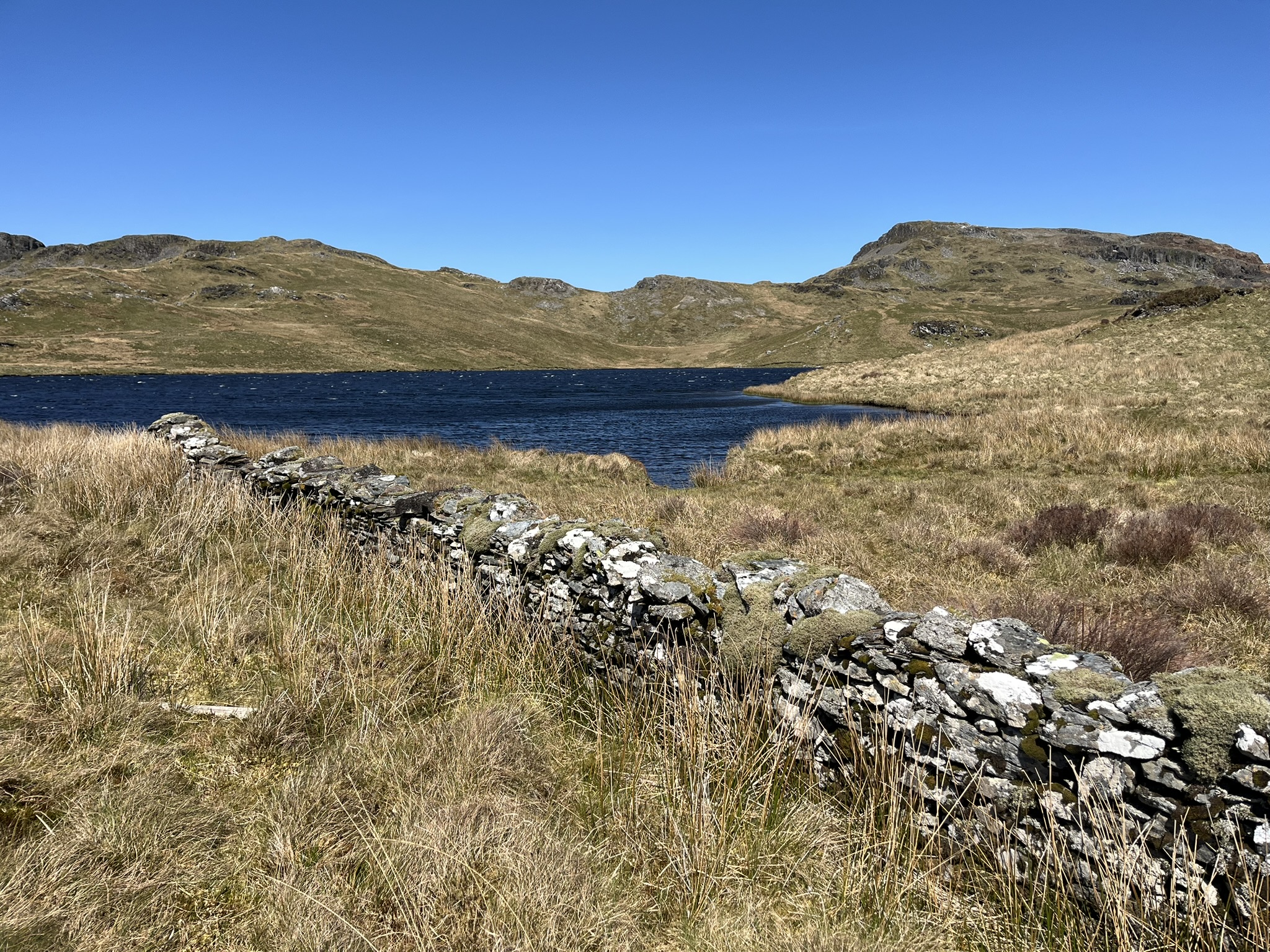
We pass an old farmhouse called Cwm, a traditional Eryri type from the sixteenth century. Now the hills are beginning to close in and the track expires. There’s a steep climb ahead, out of the valley and on to the upland of the Migneint. It’s heavy going. I’m suffering from a heavy cold, and lag at the back. At the top of the slope, after a long diversion to find a stile over the road that crosses the Migneint to Ysbyty Ifan, we splash over boggy ground towards a reservoir, Llyn y Morwynion. By now the wind has risen still further, to a gusty gale, whipping up waves on the lake and pushing against us.
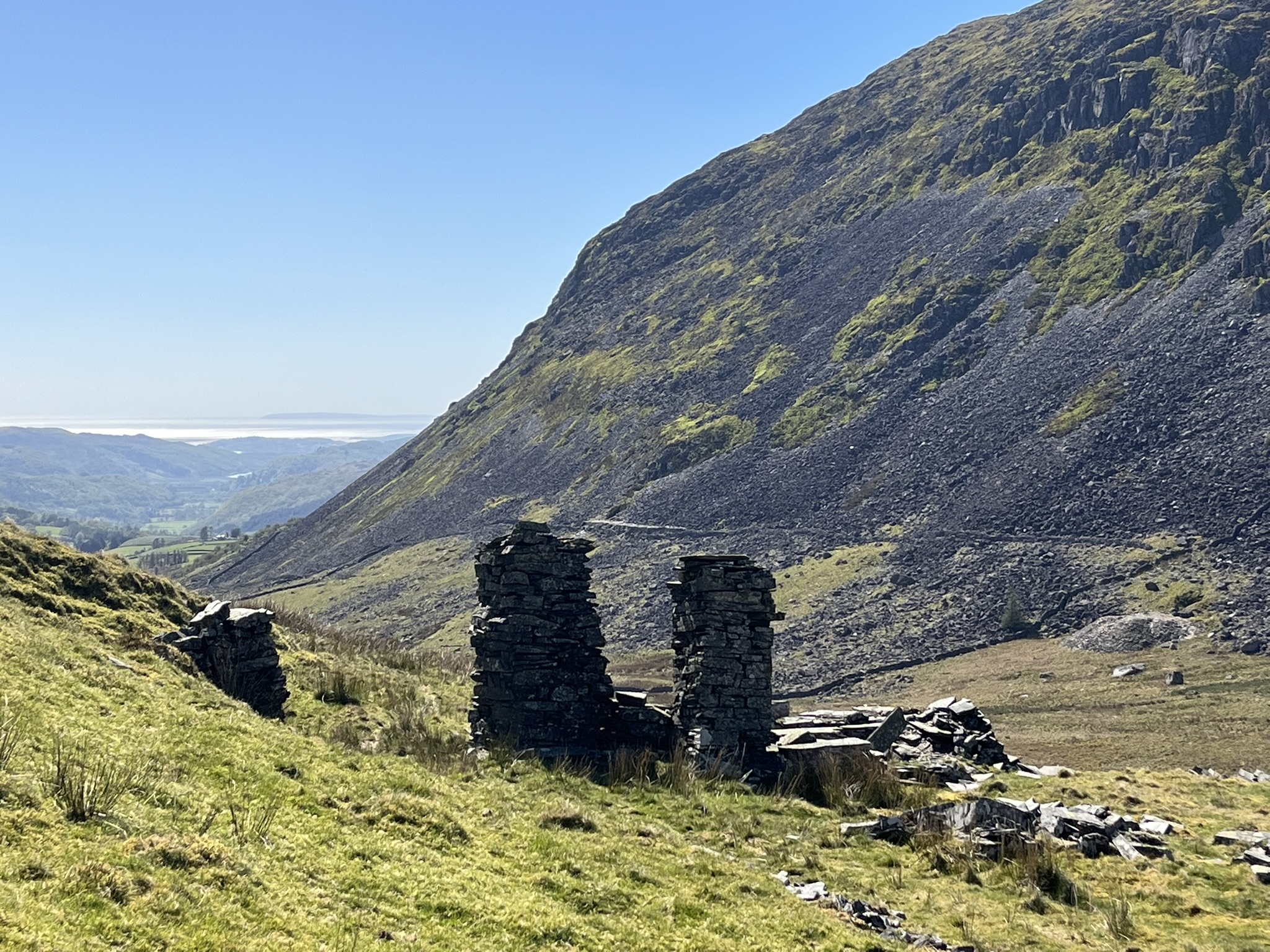
The path descends, with views back to the Moelwyns and Blaenau Ffestiniog. For a while we enjoy some level lower level walking. Two walkers from Belgium overtake us – why are Dutch and Belgian people so fond of Welsh mountains? – and are soon out of sight ahead of us. Now we face another long climb back on to the Migneint up above Cwm Teigl. There’s not a cloud in the sky, but the wind was lashed itself into a gusty fury. It threatens to push us off the path, and constantly saps us of energy. Somehow, whichever direction we walk in, we’re battling against it. Next, there’s a steep descent, past a ruined house, to a narrow road leading uphill to the large Manod quarry. Old film footage shows ancient lorries struggling up this road, loaded with paintings from the National Gallery to be hidden in the underground caverns during the Second World War. Quarrying still goes on here, in what is now called the Cwt-y-bugail quarry. It’s said to be the highest industrial site in Britain. We wonder who can afford to buy Welsh slate these days.
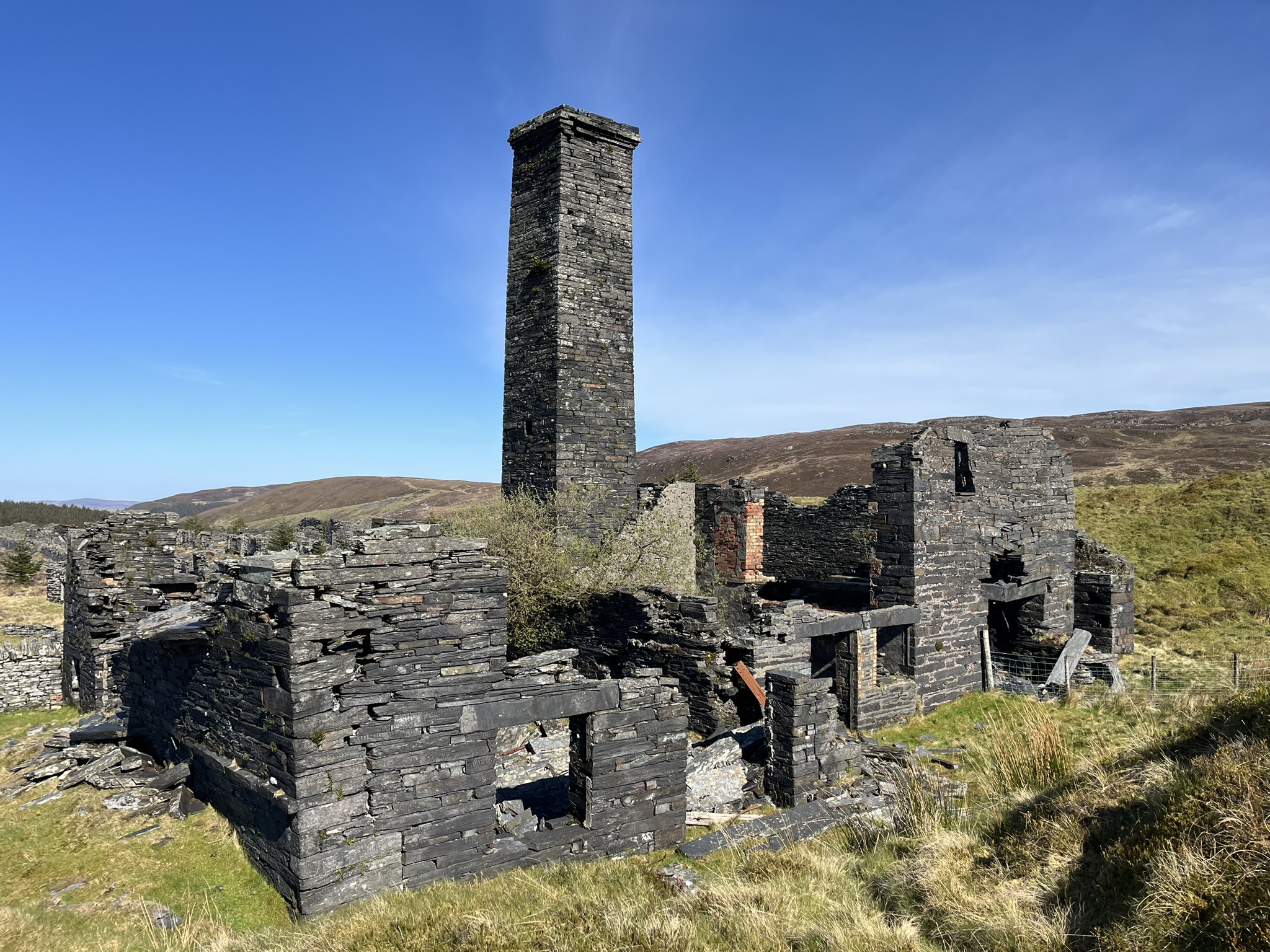
After a struggle to gain the summit of the road, we branch off on a track to the right. We’re on high ground here, and the wind is still beating against us in fitful bursts. Another disused quarry, Blaen-y-cwm, is to our left. We’re making for a squat slate ruin ahead. When we reach it, the track stops abruptly. We find ourselves staring down at an amazing scene. The squat building is a sheave, operating the machinery on a steep incline that plunges away from where we’re standing. At its foot is a small Pompeii – the ruins of the village that was the Rhiwbach Quarry.

With care we descend the long, steep incline, which once carried slates out of the quarry. At the bottom, amid huge slate tips to either side, are remains of many buildings, including a tall tower (the incline’s engine house), workshops, barracks for the workers and their families, rows of lavatories, a shop and a school. From 1909 a teacher, Kate Hughes (later Griffiths), used to ride in an empty slate wagon up Manod Mawr, and then walk down to the village, to teach the local children. She would return to Blaenau Ffestiniog by rattling dangerously down on a car gwyllt (‘wild car’), a workers’ sled or skateboard, on the tramway. We pick our way through the village. How men, woman and children could have led any kind of comfortable life here, halfway up a bleak mountain, seems inconceivable today.

After a short spell in forestry we pass a breached stone dam, and then start the long descent into the small village of Cwm Penmachno that we can see far below. It’s tough going. This time it isn’t the wind that’s to blame. The zig-zag slopes are unrelenting, and the walking surface of shattered slate is hard on our feet.
We have a rest in the village and plan what to do next. We’re already exhausted, but Penmachno, our destination, is another three or four miles away. We wonder about cheating and summoning the taxi to rescue us where we are. But there’s no phone signal – C1 tries a phone box, but that doesn’t work either – so there’s no way of talking to the taxi firm. No option, then, but to keep on walking. We can’t face following the route of the Trail, which features a long, monotonous stretch through forestry, and decide instead to walk along the quiet, level road to Penmachno.

We’ve just enough time for a short drink outside the Eagles Inn – with the sound of a brass band rehearsing round the corner – before the taxi arrives to take us to where we’re staying the night in Betws-y-coed. After a quick pizza each we’re ready for an early night’s sleep. Today’s walk was only thirteen miles, but, thanks to the savage wind and the hard terrain, it’s felt much longer. Tomorrow’s walk promises to be easier.

Leave a Reply