In my crueller moments I like to think that Dr Richard Beeching is still suffering in purgatory for his destruction of the Welsh railway system. He left it in such a state that you can’t travel by rail between the country’s two main concentrations of population without a long diversion into England. Despite that, C1 and I have decided to go to Blaenau Ffestiniog by train: Swansea to Crewe, Crewe to Llandudno Junction and Llandudno Junction to Blaenau, a journey of seven and a half hours (it would have been getting on for four hours by car).

As soon as we get to Swansea station we know there’s trouble. The Manchester train is delayed. And then delayed more. Something to do with a signal at Whitland. Finally, we’re off, accompanied by a raucous group of over-70s from Neath, well launched into their supplies of white wine, Baileys, rum and something called Tequila Rose. It’s already clear that we’ll miss our connections. We’ll have to wait three hours for the last Conwy valley train of the day. But by good luck M, our guestwalker, who’s coming from Wakefield, diverts his car journey and gives us a lift from Gobowen station. C2, coming from Winchester, isn’t so lucky. He too misses his connection. He finally manages to catch the last train to Blaenau, and joins us after dusk.

In the morning our travel problems continue. Our taxi fails to turn up, leaving us shivering in the cold morning air. Finally it arrives, after a phone call, and drops us at the waterside at Tanygrisiau, our starting point for Part 2 of the Slate Walk. Then things start to look up. The route takes us on a small lane through the village, a homely tangle of cottages, short terraces and chapel alongside the Ffestiniog Railway. We pass the tiny house where Meredydd Evans (Merêd) was brought up. He was a man of many accomplishments – singer, journalist, folk music pioneer, BBC executive, language campaigner, philosopher and political radical – and I’ve always counted myself lucky to have known him. A little later we pass Afallon, the home of Robert and Mary Silyn Roberts, a couple portrayed in Angharad Tomos’s fine novel, Arlwy’r ser. Both were pioneers of adult education in north Wales through the WEA, and Mary was a lifelong advocate of peace and women’s rights.

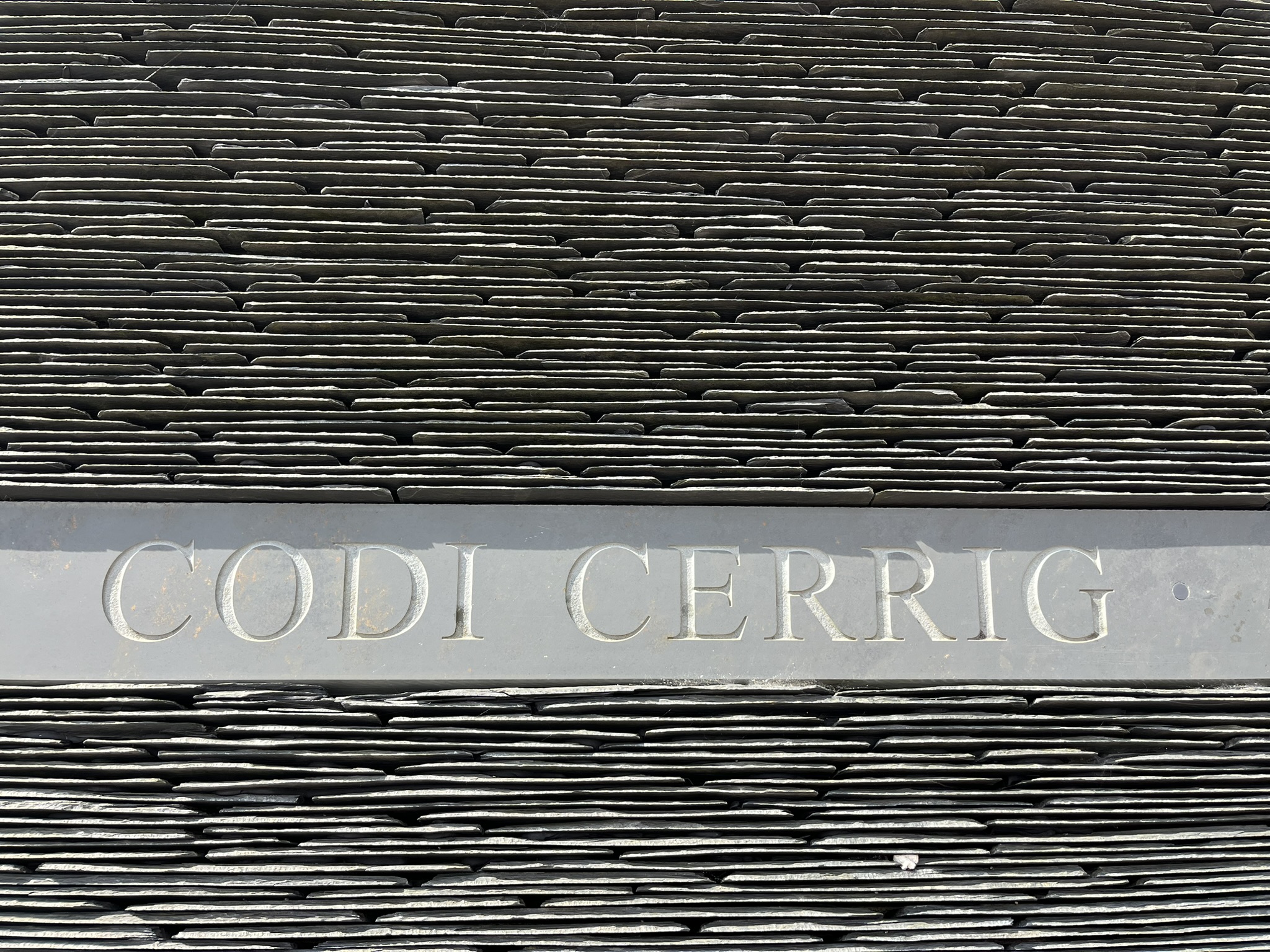
Tanygrisiau merges into the outskirts of Blaenau Ffestiniog. Blaena or Stiniog, in local usage, stretches along its high contour under the mountains for over two miles, ‘breichled o dref ar asgwrn o graig’ (a bracelet of a town on a bone of rock), in the words of Gwyn Thomas. It’s the slate town par excellence. Its population has shrunk from 12,000 in its industrial heyday to less than 4,000 today, but it’s still a place of striking character, and one that celebrates its creative past and present. Its people remain highly loyal to the Welsh language, and they celebrate its finest poet, Gwyn Thomas, with words are carved into slates throughout the town. The route takes us on a sinuous route, starting with a panoramic view of the town from the south. We cross a railway bridge, in time to see a train steaming towards us on the Ffestiniog Railway. This prompts C2 and M to debate the allure of antique trains, and the role of nostalgic thinking more generally in the rise of the radical right in Britain.

Grey is the near-universal colour here. Almost no one uses bright colours on their houses. The older terraced houses, built with huge blocks of stone, seem to have rocky hills or slate tips growing straight out of their roofs. We pay a visit to Capel Rhiw in Glanpwll, the studio for many years of the wood sculptor David Nash (alas, no one’s at home), and then amble down Blaenau’s main street. I call in at the bookshop, Yr Hen Bost. The owner is welcoming, but she says, with an air of sadness, that passing visitors are few these days. We retrace our steps and have a bite in Caffi Antur Stiniog, the choice of the many other hungry people in this town.

The path leaves the main street and the town, drops down a grassy slope and passes through through a mysterious woody glade, full of birdsong, before climbing through several areas of wrecked and derelict vehicles (one of them, M. notices, is ‘a very rare SsangYong Rodius’). We point our cameras at the alluring scene: twisted and rusting metal in the foreground, slate tips and craggy mountains behind. Looking back, we can see the Moelwyn range and the hydroelectric dam, Llyn Stwlan, high up on its flank. We overtake three women who are also doing part of the Slate Trail – the first such walkers we’ve met since the start – and we exchange walking experiences.

We’re now in Cwm Bowydd, quiet, green farmland very different from the kingdom of slate to the north. The path winds up and down until we find ourselves in Coed Pengwern, a wood of deciduous trees and then tall, slim pines, where our feet tread softly on a carpet of needles, twigs and cones. Below, in a gorge to our right at the foot of a steep slope, is Afon Teigl. When we reach the river we double back to a curious footbridge with a gate in the middle, presumably to confound sheep (for some reason C2 is reminded of an East-West crossing in Berlin during the Cold War and poses mid-bridge like a John Le Carré spy).

To prepare us for the more challenging terrain of Day 6 the route planners end the day by making us climb a long hill to the village of Llan Ffestiniog (locally, just ‘Llan’). As we emerge on to the main road a police car, lights flashing, flags down a biker, who’s clearly committed a misdemeanor. There’s a long conversation between policeman and biker, in which the biker, clearly good at talking, does his best to minimise his punishment. We miss the outcome, because just then our taxi arrives – before we have a chance to try out what the community pub, the Pengwern Arms, has to offer.

Our hotel, Plas Weunydd, sits high above Blaenau Ffestiniog, and was once owned by the Greaves family, the owners of the local slate mine. (Naturally, bosses preferred to live at a healthy distance from their workers.) We’re sharing it with a large group of people on a corporate away-day. They seem jollier and more enthusiastic than colleagues on similar improving events that we made our staff undergo, many years ago.

Plas Weunydd is close to the Llechwedd slate quarry. Part of the quarry is still worked, but the main activities here – zip-wiring, trampolining, mountain biking and caving – are provided by the leisure company Zip World and the community enterprise Antur Stiniog. For some reason C1, C2 and M seem unhappy at my suggestion that we pay to have ourselves launched on a fast wire over the acres of slate far below.

Leave a Reply