It was in London that I saw the book, quite by chance. The picture on its cover, ‘The force that through the green fuse drives the flower’, by Ceri Richards, was instantly familiar. The title, The script of the stones: a short walk at the end of the world intrigued me (as does any book title containing the word ‘walk’, of course). And when I read that it was entirely concerned with half a mile of the south Gower coastline, there wasn’t any doubt. I needed to read it.

Ever since his youth, Francis Gooding, the grandson of Ceri Richards and the son of Mel Gooding, has had the good fortune to visit, at least once a year, a house on the clifftop lane at Southgate near Pennard. He developed an early fascination with the natural world, especially birds and what he calls ‘small things’. In The script of the stones he distils into language years of observing, often in minute detail, what lay immediately outside the front door of the house. After distilling comes maturing, in this case the maturing of wider thoughts, thoughts that wander deep into the history of the earth and its inhabitants: what Gooding calls ‘straying all over the place’.

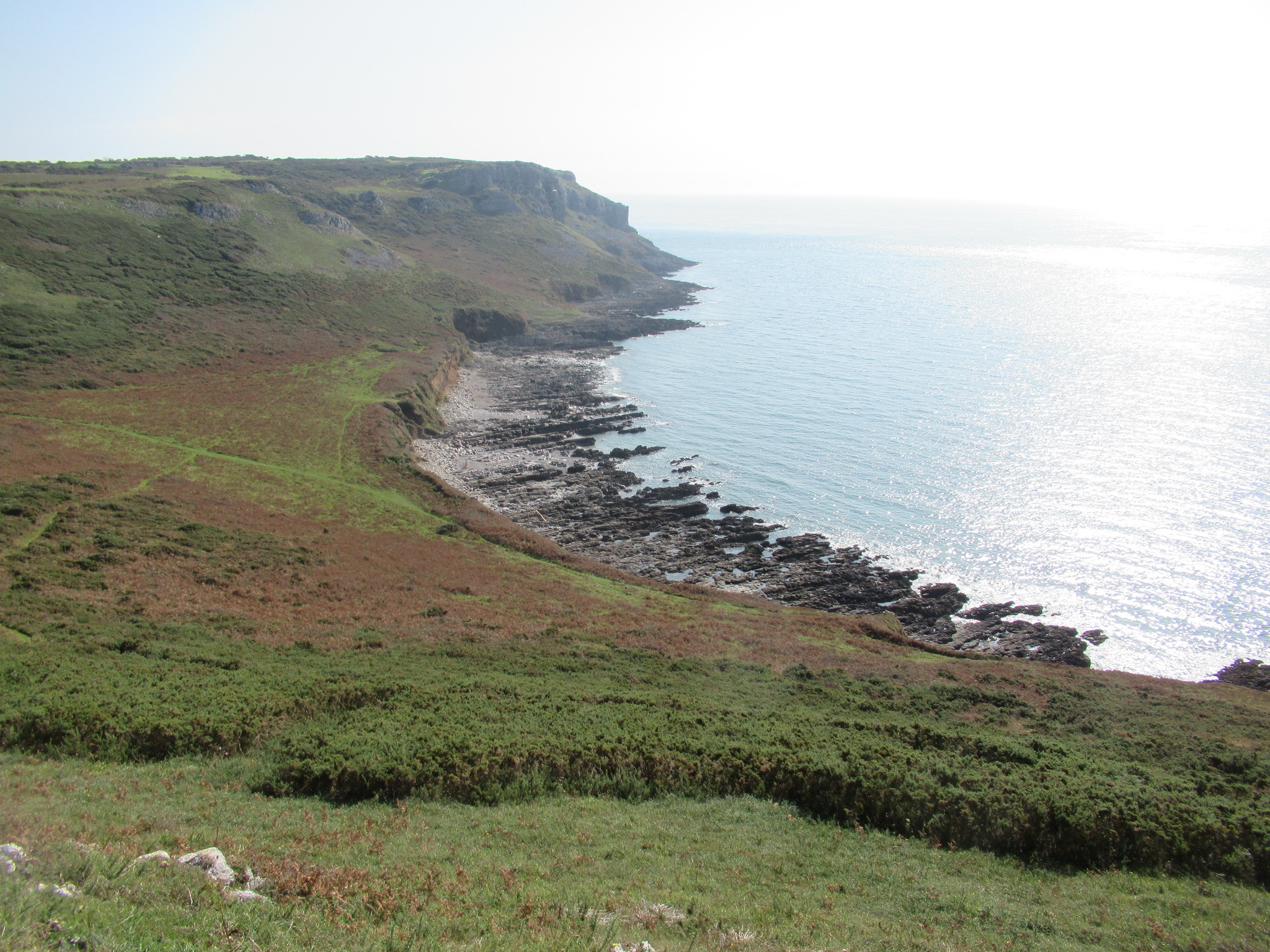
‘A short walk’, because spatially, like Gilbert White, Gooding seldom strays far from his home patch – the clifftop, slope and shoreline between Hunts Bay and East Cliff. He scrutinises this small area in all seasons and weathers, sometimes with Opticron lens in hand, in a series of chapters, each concerned with a particular ‘filter’ for viewing the land. The first chapter, on rocks, introduces the themes of deep time and ephemerality. In the second he gets close to (and even tastes) the thin soils that cover the rocks. Then follow sections on plants, ‘small things’ including insects, caves, rockpools, birds and mammals. He insists on the severe limits of his expertise, but it’s clear that over the years he’s laid up a vast store of knowledge about the natural world. His take on species can be surprising. He’s impressed by the beauty and fearlessness of slugs, and even ‘the unpalatable slime in which they are completely enrobed, like an inedible chocolate’. In gardens, though a pest, they’re no more than ‘diligent agents of entropy’. Birds, though, are surely his favourites. At one point he uses his phone to replay the song of a dunnock, keen to entice it out of hiding; when it emerges, he feels shame in having deceived the bird.

‘At the end of the world’ might suggest that the book belongs to apocalyptic nature writing, a genre common enough now that news of fresh climate and species disasters reach us every day. But though he’s dismayed by the depletion, and sometimes complete loss, of Gower species, what disturbs him even more is that the cruelty and indifference humans display towards animals and other creatures parallel the cruelty and indifference they’re capable to showing to their own kind.
Humans, as much part of nature as any creature, feature centrally in this nature book. Some are thinkers of the past whom Gooding calls to his aid – Thomas Browne, William Blake, J.A. Baker, Friedrich Nietzsche, Rosa Luxemburg and many others. Others are local heroes whom he celebrates, like the geologist Emily Dix, naturalist Mary Gillham, poet Vernon Watkins and his own uncle, who introduced him to birds. Others again are villains. In the chapter on mammals Gooding segues from the slow, ruminative life of cows, and the question of whether they live ‘in the present’ or whether they have an inkling of their imminent, terrible deaths, to the slaughterhouse and then, via the Bauhaus and one of its students, Fritz Ertl, the (literal) architect of Auschwitz, to the mechanised murder of Nazi death camps.

This bold movement of associative ideas, together with the scholarly apparatus, the inclusion in the text of murky black-and-white photographs, and a delight in what can be done with language, suggests that one of Gooding’s stylistic models is W.G. Sebald, and especially his most famous book, The rings of Saturn, also a local walking book with global reverberations. In the launch of his book held in Tabernacle, Mumbles last week, he confirmed this. It’s interesting, though, that he dispenses with the dreams, illnesses and other devices Sebald uses to make his transitions.
Gooding’s writing can be lyrical and transcendental, and the language can sometimes verge on the overloaded, although he has a disarming gift for self-deflation. In the section on soil he rhapsodises on the idea of Mother Earth as the provider of nurture and meaning, roots and culture, before stopping to remind himself that ‘blood and soil’ was a central Nazi trope, and that some nature writing, like that of Henry Williamson, contains the seeds of fascist doctrines.

The script of the stones isn’t an overtly political book, and Gooding doesn’t pursue his suggestion that capitalism and the survival of the planet may be incompatible. Though he does recall his father saying that ’the vision of Marx had failed only insofar as he had not considered that capitalism might in fact destroy the living earth before it reached the point of collapse.’
Some of the most impressive sections of the book are when Gooding isn’t expanding his lens beyond the cliffs of Southgate, but when he listens intently to a small creature, and, somewhere in the journey from ear to brain to pen, comes up with the magical words to convey the listening experience. On almost every page there are passages like this:
A thrush sang from cover somewhere, uttering a series of varied phrases and proposals, lines and words and oratorical flourishes, delivered in a slight rush, though with very good diction. Each statement in a thrush’s soliloquy is enunciated with both precision and a sense of great novelty, as though every whinny, crackle, whistle or tic were a brand new invention, minted in the syrinx at that very moment for the first time, its communication of urgent import. Thrush song is a performance. It never gives the impression of being merely a call, a beacon or a reflex utterance, as can sometimes be the case with other birds; the thrush is always seeking an attentive listener, an audience for its ur-sonata, with what seems like increasing insistence.
Of the coastline between East Cliff and Hunts Bay Francis Gooding writes, ‘I feel the place in me like a woodgrain. It has never not been part of my life’. Reading and re-reading The script of the stones gives you more than a glimpse into his accumulated experience of the place, and what it means to him. His ‘short walk’ takes him, and us, a long way into the heart of nature and human nature.

Leave a Reply