
It’s a truism to say that the destruction of trust is at the heart of societal decline. We’ve known for a long time that politicians come bottom, or close of bottom, in league tables of professions in whom the public has confidence. It’s no surprise to find that, since the financial meltdown of 2008, bankers also score poorly. What’s noticeable, though, is how quickly the erosion of trust has widened and accelerated in the much more recent past, undermining hope in a better future. The triumph of ‘populist’ politicians (Orban, Erdoğyan, Trump, Bolsonaro, Johnson) is best viewed as an outcome of this rapid collapse of faith – in the structures we’ve inherited, in the possibility of social and economic progress, and in the primacy of evidence and truth.
One of the most damaging of these losses, I think, is the way support has foundered for ‘permanent institutions’ – organisations, or networks of organisations, that we once thought would resist the attacks of time, because they fulfilled functions essential to a modern, progressive society and because they enjoyed wide public support. These bodies have seen their foundations crumble, for a number of reasons.

One of the permanent buildings in most town high streets was the bank – typically built of expensively quarried and carved stone, and intended to impress and persist. Between a third and a half of them have been closed and sold, within less than a decade. Electronic banking is usually blamed. But it isn’t the only factor. Another is the death of the belief that retail banks in some way exist to serve their customers, including local customers. Today’s banker holds customers in disdain. They only exist to be exploited for their passive reluctance to shift banks for better treatment. The banker would rather spend time making more money through the sorts of complex ‘instruments’ that brought about the crash. The idea that banks might have some useful social purpose would strike him (it’s still usually a ‘him’) as absurd.

If that’s been the fate of banks, it’s no surprise that the public bodies privatised since the 1980s have followed suit. Think how the Post Office has shrunk from a proud public asset to become a grubby commercial outfit that seeks to exploit and cheat its workers (as in the Horizon scandal), and provide a service that maximises the cost to their users and the profit to themselves. Having abandoned its old, elegant Edwardian building, the local post office now cowers at the back of some backstreet shop. British Rail may have been much complained about, but the public has lost so much trust in its successors, the privatised rail companies, that periodically a Tory government finds it has no option but to renationalise the worst of them.

Permanent institutions that remain in the public sector have suffered predations from two directions: the ‘austerity’ unleashed by George Osborne and still rampant (despite periodic claims that it’s ‘over’), and a turbocharged ideological attack on public or community provision. Johnson’s new triumphalist government has injected new energy into the ideology-driven effort to undermine the few remaining collective institutions of national importance. The leaders of the BBC have taken the greatest care in recent years, in their news and current affairs output, to avoid antagonising Conservative opinion, but it’s done them no good: the Tory mission to weaken and, if possible, emasculate the Corporation is gathering steam. A similar process threatens the legal system. The combination of direct sniping (judges as ‘enemies of the people’) and past cuts (the near collapse of the legal aid system) is just a prelude for a more systematic attack, typified by the current threat to abolish judicial review as check on the legality of executive action, and the recent appointment as Attorney General of Suella Braverman, who wants to ‘take back control’ from ‘judicial activism’..

‘Austerity’ – in origin an ideological weapon, disguised as economic necessity – has been even more effective in weakening institutions. The attraction of austerity to its inventors was that its disciplines could be imposed comprehensively, even in areas, like Scotland and Wales, where the Tories didn’t hold political power. So, in Wales, as the health service has taken up more and more of the Welsh Government’s budget, permanent institutions have seen their resources reduce virtually every year. Local authorities, once active across a large range of services, can perform not much more that their statutory, unavoidable duties. And their ability to give strategic guidance, in planning economic and social futures for their localities, has been badly damaged.
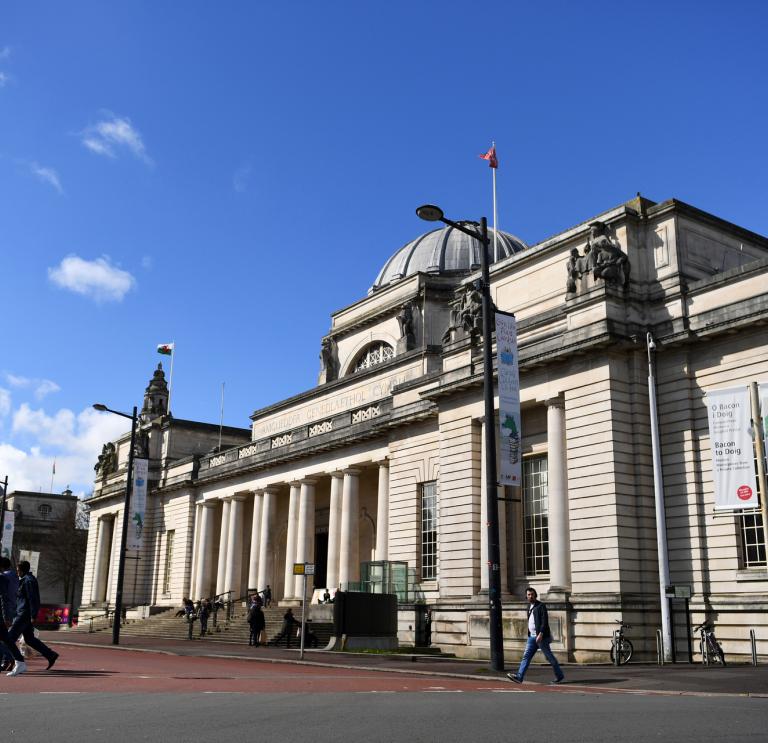
Our national institutions had suffered the same fate. Take cultural institutions as an example. Grant-giving bodies like the Arts Council of Wales find they can’t fund their clients as they once could: this in turn weakens a whole range of permanent institutions, like theatre companies, galleries and orchestras. Older permanent institutions, like Amgueddfa Cymru – National Museum Wales and the National Library of Wales, have lost so many resources, especially staff, over so many years, that they’re now barely able to perform the core responsibilities imposed by their charters.

Does all this matter? Some may be tempted to think, no. The days of ‘permanent institutions’, they argue, are gone. We live in the age of the sound-bite, the pop-up and Snapchat: the transient and the impermanent. The old bodies belonged to a different age: they’re not in contact with the young, the excluded or just the zeitgeist. Better to support, with declining cash, leaner and more responsive organisations, and forget about the old ones, with their classical facades and ancient charters.
But I think there are good reasons for reviving and cherishing our permanent institutions. First, they perform vital functions that wouldn’t get done otherwise – like collecting, safeguarding and giving access to our national past: we need our custodians and curators. Second, they give support and a lead – or they ought to – to smaller, more local organisations in their field. And third, they help to tell us who we are (and will be), in a country like Wales that, for historical reasons, possesses few national permanent institutions. We need to have trust in them, and their ability to adapt to suit new times. We allow them to wither at our peril.
I realise this defence makes me look like a conservative. And it’s true that it used to be Conservatives who mounted this kind of argument. But it’s a topsy-turvy world. For our current rulers conserving institutions is the lowest of priorities: their world-view is Trotskyist in its enthusiasm for continuous, ‘creative’ destruction.

Leave a Reply to Richard Powell Cancel reply