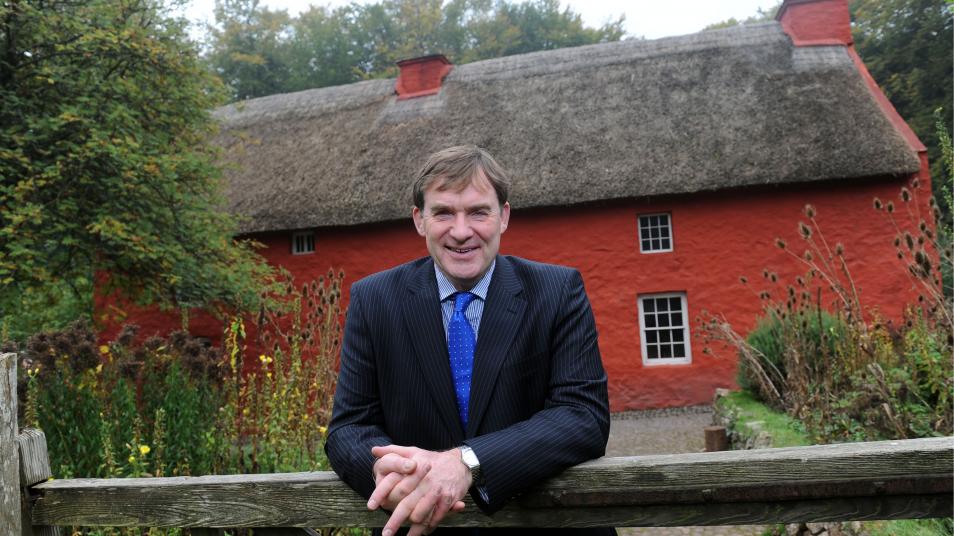

The 2021 Richard Burton Lecture in Swansea University was given this week by David Anderson, Director General of Amgueddfa Cymru (‘Amgueddfa Cymru – National Museum Wales’, to give it its hyper-awkward formal name). His title was ‘Do Welsh museums matter?’ It was a learned and a challenging talk, raising crucial questions about the role of museums today. Hywel Francis, the Lecture’s originator, who died in February 2021, would have nodded in agreement at many points.
David Anderson’s thesis was clear, and relied explicitly on a sharp contrast between ruling government ideologies in Westminster and Cardiff. The former he labelled ‘neoliberal’ – left undefined, although coupled with the word ‘corrupt’, interpreted, interestingly, as ‘the theft of the value of a decision’. Opposed to neoliberalism was the dominant model in the Welsh polity, which still kept a strong link with what Anderson saw (too rosily?) as the highpoint of ‘government for the people’, the Attlee government of the late 1940s, and the formulation of a set of universal human rights, including the right to participate in cultural activities.

Curiously, David Anderson found fault with the Attlee government on the grounds that its welfare statism excluded cultural rights – even though the period saw the establishment of the Arts Council of Great Britain and the celebration of the Festival of Britain. Even today, he claimed, there is an uncomfortable silence in museum circles about cultural rights and their promotion. The only reason he could think of was that claiming or encouraging cultural rights meant making radical and uncomfortable changes in museum practice.
Museums in Wales, according to Anderson, had both an opportunity and a duty to support the distinctive Welsh social model. While national English museums rely less and less on the state for their funding, and more and more on corporate sponsors and their dark designs, Welsh institutions remain largely publicly financed. It was not, though, just a matter of ‘following the money’. Museums in Wales needed to act, through conviction, to support movements towards greater democracy, more active participation and social justice.

David Anderson gave examples of how Amgueddfa Cymru had recently tried to put this idea into practice: by involving community groups in the development of the ‘new St Fagans’, by emphasising the role of ‘doing’ and ‘making’ as well as absorbing information in a visit to the site; by throwing open museum spaces to meetings of ethnic minority groups; by inviting members of Extinction Rebellion to make a stand in the foyer of the National Museum in Cardiff; by allowing community groups, rather than curators, to decide the content of exhibitions; by challenging the traditional museum ‘reading’ of a figure like Thomas Picton; by inviting peoples’ testimonies of the experience of Covid; by installing copies of pictures from the collections inside hospitals. If passivity is the enemy of democracy, if our capacity to know things is compromised by social forces (‘epistemic injustice’, in Miranda Fricker’s phrase), then Amgueddfa Cymru has a responsibility to encourage active individual and collective action.
It’s hard to argue with this line of argument, at least in Wales. (Anderson wondered whether English museums might revert, post-Covid, to their comfortable old ways, like staging populist exhibitions on celebrities.) Not only do museums have to be relevant, especially to those deterred by what one questioner called ‘the doors of an august institution’, they need to be part of a more general social trend towards greater democracy, civic participation and social justice.
This road may be comparatively new to museums, though it’s by no means new to other cultural organisations, even among memory institutions. But it’s not always an easy road.
For one thing, you need to convince other people of your vision: your colleagues, the government and the museum’s public. If you now feel that the activities like exhibitions should be led by community groups rather than your colleagues – David Anderson’s version of the traditional formula was ‘we [museum staff] lead, you [people] listen’ – then where does that leave the curators? Are they another group of ‘redundant experts’, to paraphrase Michael Gove? Politicians are rarely known for their natural commitment to arts and culture: will the museum director who follows a socially radical path automatically be rewarded by funding or official attention?

There’s also a danger of ‘bandwagoning’ – of responding to each social issue as it reaches public prominence, at the expense of paying attention to longer-standing matters of public policy. It’s been an agreed, cross-party position in Wales for decades that the Welsh language needs to be safeguarded and promoted. But Amgueddfa Cymru as an institution, despite the efforts of many individual staff, has never succeeded in transcending its ‘Anglophone’ reputation to play its proper role in encouraging use of the Welsh language.
Daniel Williams, in his summing up, asked a penetrating question. If the main aim of all cultural institutions is to play a leading role in developing the ‘new welfare state’, how would you tell them apart? In other words, social radicalism alone isn’t enough. Each institution has a distinctive set of aims, functions and duties, many of them humdrum or unfashionable, but all essential to its success: in the case of a museum, safeguarding, conserving, giving access, telling us what objects they have (a job museums have been very poor at). Convincing funders and politicians that these need attending to is a much harder task than demonstrating social orthodoxy.
‘Welsh museums’, in Anderson’s talk, turned out to mean Amgueddfa Cymru. This was understandable – he said he was reluctant to speak on behalf of other institutions – but it left you uncertain about whether his central thesis applied equally to local as well as national museums. The omission meant that he missed one of the most critical function of most museums, to act as a powerful ‘focus of localness’ for communities united by their proximity. At a time when the virtual world has dissolved geographical distance and multiplied remote communities, museums are one of the few public bodies left to remind people of their place in the local community, and of their shared past. That last word was also strangely absent from David Anderson’s talk. The past, after all, is still relevant to museums, and to most of us. As William Faulkner wrote, ‘The past is never dead. It’s not even past.’
At the end David Anderson gave us his answer to the question he posed at the start, ‘do Welsh museums matter?‘ They do, he said, ‘if they fulfil their purposes’. I wasn’t sure he’d convinced me about what those purposes were.


Leave a Reply to Colin Cheesman Cancel reply